

The source of the book
This book is published for the public benefit under a Creative Commons license, or with the permission of the author or publisher. If you have any objections to its publication, please contact us.
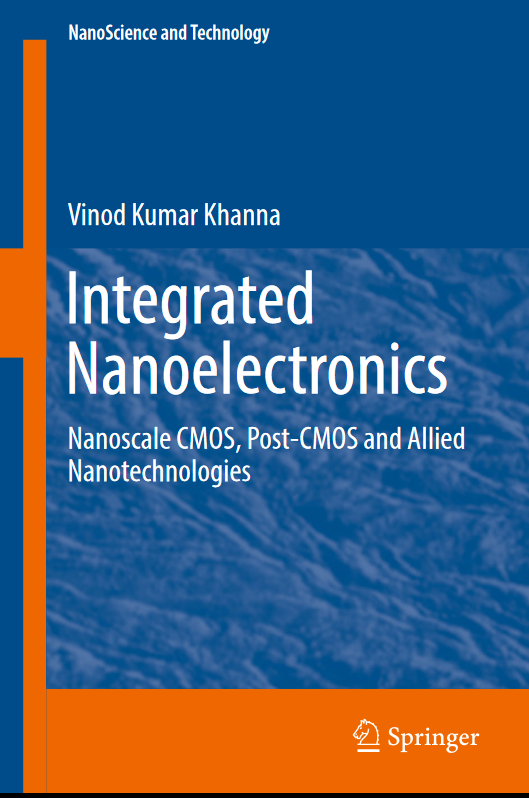
Integrated Nanoelectronics: Nanoscale CMOS, Post-CMOS and Allied Nanotechnologies PDF - Vinod Kumar Khanna
Vinod Kumar Khanna • Nanotechnology • 30 Pages
(0)
Author
Vinod Kumar KhannaCategory
TechnologySection
Number Of Downloads
69
Number Of Reads
108
File Size
0.95 MB
Views
1,206
Quate
Review
Save
Share
Book Description
About Integrated Nanoelectronics by Vinod Kumar Khanna
Integrated Nanoelectronics: Nanoscale CMOS, Post-CMOS and Allied Nanotechnologies is a comprehensive academic and professional reference that explores the rapidly evolving world of nanoelectronics, advanced semiconductor technologies, and interdisciplinary nanoscience. Written by experienced researcher and scientist Vinod Kumar Khanna, the book presents an in-depth examination of nanoscale CMOS technologies, post-CMOS architectures, and the broader ecosystem of nanotechnologies that support the future of electronics and intelligent systems.
Published as part of the NanoScience and Technology series, this work is designed for readers seeking a strong understanding of how modern nanoelectronic systems are evolving beyond traditional semiconductor scaling. The book connects multiple scientific domains including nanomagnetics, nanophotonics, nanomechanics, nanobiotechnology, MEMS, spintronics, graphene electronics, quantum-dot systems, and nanoscale fabrication techniques into one integrated framework. (Springer)
A Deep Exploration of Nanoscale CMOS and Beyond-CMOS Technologies
One of the strongest aspects of this book is its detailed explanation of how classical CMOS technology is approaching physical and practical scaling limits. The text carefully guides readers through the transition from traditional MOSFET devices toward emerging nanoscale transistor architectures and next-generation nanoelectronic systems.
Topics such as short-channel effects, SOI-MOSFETs, Trigate FETs, and FinFET technologies are presented in a structured and technically accessible way. The discussion then expands into advanced post-CMOS concepts including:
Tunnel field-effect transistors
Quantum dot circuits
Single-electron electronics
Semiconductor nanowires
Carbon nanotube electronics
Graphene-based nanoelectronics
Quantum cellular automata
Nanomagnetic logic systems
The book successfully bridges theoretical foundations with engineering applications, making it valuable for both advanced learners and practicing researchers in electronics and nanotechnology. (Springer)
Interdisciplinary Nanotechnology in One Integrated Resource
Unlike many specialized semiconductor textbooks that focus on only one branch of nanotechnology, Integrated Nanoelectronics adopts an interdisciplinary approach. The author emphasizes that modern nanoelectronics no longer exists in isolation and increasingly depends on collaboration between several nanoscale disciplines.
Readers are introduced to interconnected technologies such as:
Nanophotonics for high-speed optical communication
Nanoelectromechanical systems (NEMS) for sensing and actuation
Nanobiosensors for biomedical and chemical applications
Spintronics for magnetic data storage and computation
Nanofabrication techniques including top-down and bottom-up manufacturing
This broader perspective makes the book particularly useful for students and engineers working in areas such as microelectronics, semiconductor engineering, nanoscience, MEMS technology, integrated circuits, materials science, quantum electronics, and emerging computing systems. (Springer)
Clear Structure for Students, Researchers, and Engineers
The book is organized in a progressive manner that helps readers move from foundational nanoscience concepts toward advanced nanoelectronic architectures. Early chapters introduce nanomaterials and nanoscale properties before transitioning into CMOS scaling challenges and supportive nanotechnologies.
Later sections explore future-oriented technologies including molecular electronics, graphene devices, rapid single-flux quantum logic, and advanced nanocharacterization methods. Each chapter includes review exercises and bibliographic references that support further academic study and research exploration. (Springer)
Because of this structure, the book can serve multiple purposes:
Graduate-level university textbook
Research reference for nanotechnology laboratories
Supplementary material for semiconductor engineering courses
Technical resource for electronics professionals
Introduction to post-CMOS and emerging computing paradigms
Technical Depth with Practical Relevance
A major advantage of this work is the balance between scientific depth and practical engineering relevance. Rather than presenting nanotechnology as an isolated theoretical subject, the author continuously relates nanoscale concepts to real-world applications and future technological trends.
Readers interested in areas such as:
- Ultra-scaled semiconductor devices
- AI hardware acceleration
- Neuromorphic computing
- Low-power electronics
- Advanced integrated circuits
- Quantum and spin-based computing
Nanosensors and biosensing systems
will find the material especially relevant. The book also reflects the growing importance of integrating multiple nanotechnologies to overcome the limitations of conventional silicon electronics. (Springer)
About the Author
Vinod Kumar Khanna is an experienced scientist associated with the CSIR-Central Electronics Engineering Research Institute (CEERI) in India. His research career spans semiconductor devices, MEMS technologies, nanosensors, ISFET systems, microsensors, and nanoelectronic applications. His long involvement in advanced electronics research contributes significant practical insight and technical authority to the book. (Springer)
Why This Book Stands Out
Integrated Nanoelectronics stands out because it combines multiple emerging nanotechnology disciplines into one coherent and technically rigorous resource. Instead of treating nanoelectronics, nanophotonics, spintronics, and nanobiotechnology as isolated topics, the book demonstrates how these fields increasingly overlap in modern electronic systems.
For readers searching for books on:
- Nanoelectronics
- Nanoscale CMOS
- Post-CMOS technologies
- Advanced semiconductor devices
- Nanotechnology engineering
- FinFET and graphene electronics
- Quantum nanoelectronics
- Spintronics and molecular electronics
this title offers a broad yet detailed foundation that supports both academic learning and advanced research.
Its combination of theoretical explanations, device-level analysis, fabrication discussions, and interdisciplinary coverage makes it an important reference for anyone interested in the future of integrated electronic technologies and nanoscale computing systems. (Springer)
Vinod Kumar Khanna
Vinod Kumar Khanna born on November 25, 1952 at Lucknow, Uttar Pradesh, India, is an Emeritus Scientist at CSIR-Central Electronics Engineering Research Institute, Pilani, Rajasthan, India, and Emeritus Professor, AcSIR (Academy of Scientific and Innovative Research), India. He is former Chief Scientist and Head, MEMS and Microsensors Group, CSIR-CEERI, Pilani, and Professor, AcSIR. During his service tenure of more than 34 years at CSIR-CEERI, starting from April 1980, he worked on various research and development projects on power semi- conductors devices (high-current and high-voltage rectifier, high-voltage TV deflection transistor, power Darlington transistor, fast switching thyristor, power DMOSFET and IGBT), PIN diode neutron dosimeter and PMOSFET gamma ray dosimeter, ion-sensitive field-effect transistor (ISFET), microheater-embedded gas sensor, capacitive MEMS ultrasonic transducer (CMUT), and other MEMS devices. His research interests were micro- and nanosensors, and power semiconductor devices. From 1977 to 1979, he was Research Assistant in the Physics Department, Lucknow University. Dr. Khanna’s deputations abroad include Technische Universität Darmstadt, Germany, 1999; Kurt-Schwabe-Institut für Mess- und Sensortechnik e.V., Meinsberg, Germany, 2008; and Institute of Chemical Physics, Novosibirsk, Russia, 2009. He also participated and presented research papers at IEEE-IAS Annual Meeting, Denver, Colorado, USA, 1986. Dr. Khanna received his M.Sc. degree in Physics with specialization in Electronics from the University of Lucknow in 1975, and Ph.D. degree in Physics from Kurukshetra University, Kurukshetra, Haryana, in 1988 for his work on thin-film aluminum oxide humidity sensor. A fellow of the Institution of Electronics and Telecommunication Engineers (IETE), India, he is a life member of Indian Physics Association (IPA), Semiconductor Society (SSI), India and Indo-French Technical Association. Dr. Khanna has published nine books, six chapters in edited books, and 181 research papers in national/international journals and conference proceedings; he holds two US and two Indian patents.
Earn Rewards While Reading!
Every 10 pages you read and spent 30 seconds on every page, earns you 5 reward points! Keep reading to unlock achievements and exclusive benefits.
Read
Rate Now
5 Stars
4 Stars
3 Stars
2 Stars
1 Stars
Integrated Nanoelectronics: Nanoscale CMOS, Post-CMOS and Allied Nanotechnologies Quotes
Top Rated
Latest
Quate
Be the first to leave a quote and earn 10 points
instead of 3
Other books by Vinod Kumar Khanna
'%20/%3e%3c/svg%3e "Insulated Gate Bipolar Transistor IGBT Theory and Design")
Vinod Kumar Khanna.
Communications Engineering
(0)
1004
English
Vinod Kumar Khanna.
Communications Engineering
(0)
1197
English
Vinod Kumar Khanna.
Communications Engineering
(0)
913
English
Other books like Integrated Nanoelectronics: Nanoscale CMOS, Post-CMOS and Allied Nanotechnologies
2303
English
Comments
Be the first to leave a comment and earn 5 points
instead of 3