

The source of the book
This book is published for the public benefit under a Creative Commons license, or with the permission of the author or publisher. If you have any objections to its publication, please contact us.
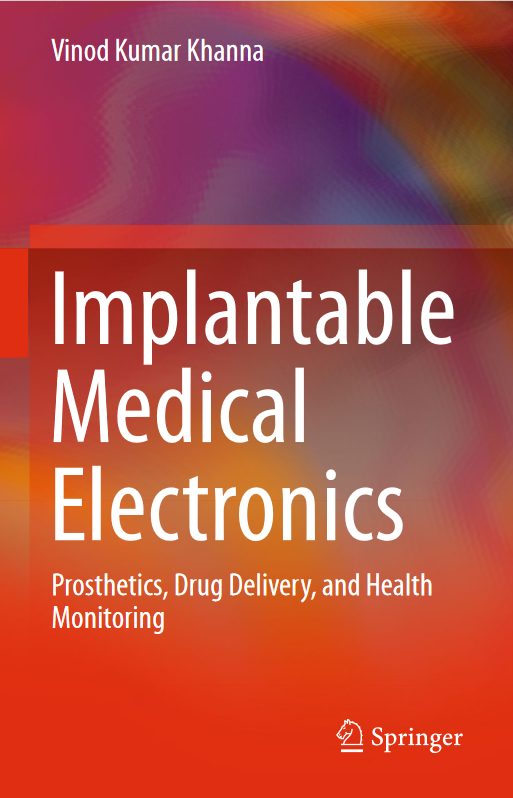
Implantable Medical Electronics: Prosthetics, Drug Delivery, and Health Monitoring PDF - Vinod Kumar Khanna
Vinod Kumar Khanna • Communications Engineering • 468 Pages
(0)
Author
Vinod Kumar KhannaCategory
fieldsSection
Number Of Downloads
32
Number Of Reads
124
File Size
14.01 MB
Views
914
Quate
Review
Save
Share
Book Description
Implantable Medical Electronics by Vinod Kumar Khanna
Implantable Medical Electronics: Prosthetics, Drug Delivery, and Health Monitoring is a comprehensive and technically detailed resource that explores the rapidly evolving world of implantable medical devices, biomedical engineering, and medical electronics. Written by experienced researcher and scientist Vinod Kumar Khanna, this book provides an interdisciplinary examination of how electronics, sensors, neural systems, biomaterials, and communication technologies are integrated into modern healthcare solutions designed to function inside the human body.
The book stands out as an authoritative guide for readers interested in implantable electronics, prosthetic systems, drug delivery technologies, and health monitoring devices. It bridges the gap between theoretical biomedical engineering concepts and practical medical applications, making it highly valuable for graduate students, researchers, engineers, healthcare professionals, and anyone working in the fields of bioelectronics or medical device development.
Drawing from advances in electronics, MEMS technology, neural engineering, and therapeutic systems, the text examines how implantable devices are transforming patient care through intelligent monitoring, precision treatment, and long-term physiological support. The author combines scientific depth with practical explanations, helping readers understand both the engineering foundations and clinical significance of implantable systems.
A Deep Exploration of Implantable Medical Devices
One of the major strengths of this book is its broad and carefully organized coverage of implantable technologies. The content moves systematically from foundational principles to advanced real-world applications. Readers are introduced to the architecture and operation of implantable systems before progressing into specialized areas such as neural stimulation, cardiac devices, implantable sensors, and controlled drug delivery mechanisms.
The book explains how implantable electronics are designed to interact safely and effectively with biological systems. Topics such as biocompatibility, implantable integrated circuit design, electrostimulation pulse generators, and wireless power transfer are discussed in detail, providing readers with insight into the engineering challenges involved in creating devices that can operate reliably within the human body for extended periods.
The discussion of implantable sensors and physiological monitoring technologies is especially relevant in modern healthcare environments where continuous monitoring and personalized medicine are becoming increasingly important. Readers gain an understanding of how sensors are used to track biological signals, monitor therapy effectiveness, and support clinical decision-making in real time.
Prosthetics, Neurostimulation, and Human-Machine Interaction
A major focus of Implantable Medical Electronics is the role of implantable systems in restoring or enhancing human function. The book explores various forms of prosthetic technology and neuroelectronic systems that help patients affected by neurological disorders, sensory impairment, or organ dysfunction.
The sections on deep brain stimulation, spinal cord stimulation, and cardiac pacemakers provide valuable insight into how implantable pulse generators and neural interfaces are used in therapeutic applications. These chapters demonstrate the growing connection between electronics and neuroscience, highlighting how modern implants can influence neural activity and improve patient quality of life.
Readers interested in neuroengineering, bio-MEMS, and brain-machine interfaces will find the material especially informative. The author explains the principles behind neural amplifiers, charge balancing techniques, and electrostimulation systems while maintaining a clear focus on practical medical implementation.
The book also addresses cochlear and ophthalmic implants, illustrating how implantable electronics can restore sensory capabilities and support communication between biological tissues and electronic systems. These discussions make the text particularly relevant for researchers working on assistive technologies and advanced rehabilitation systems.
Drug Delivery Systems and Smart Therapeutics
Another key area covered in the book is implantable drug delivery technology. Modern medicine increasingly relies on systems capable of administering precise doses of medication directly to targeted areas of the body, and this book explains the engineering principles behind those systems.
The author discusses implantable pumps, nanoparticle-assisted delivery methods, micropumps, and controlled therapeutic systems that improve treatment accuracy while minimizing side effects. This focus on precision medicine and automated therapy makes the book highly relevant for pharmaceutical engineers, biomedical researchers, and professionals working in advanced healthcare technologies.
By combining electronics with pharmacotherapy concepts, the text demonstrates how implantable systems are contributing to the future of personalized healthcare. Readers gain insight into how therapeutic implants can improve long-term disease management and enable continuous treatment without repeated clinical intervention.
Biomaterials, Power Systems, and Implant Reliability
Successful implantable medical devices depend not only on advanced electronics but also on durable materials and efficient power systems. The book devotes significant attention to biomaterials for implants, emphasizing the importance of compatibility between implanted devices and living tissue.
The sections on implant batteries and wireless powering technologies are particularly valuable for readers interested in device longevity and energy efficiency. Topics such as rechargeable implants, wireless communication, telemetry systems, and low-power electronics are explored in a practical and technically grounded manner.
The discussion extends into reliability, safety, and regulatory considerations, helping readers understand the complexities involved in designing implantable systems for real-world medical environments. The author also addresses concerns related to cybersecurity, patient confidentiality, and secure communication in connected medical implants, an increasingly important topic in digital healthcare.
An Essential Resource for Biomedical Engineering and Medical Electronics
This book is especially suitable for readers seeking advanced knowledge in:
Biomedical engineering
Medical electronics
Implantable medical devices
Neural engineering
Bio-MEMS technology
Prosthetic systems
Health monitoring technologies
Implantable sensors
Drug delivery systems
Neurostimulators and pacemakers
Graduate students and academic researchers will appreciate the book’s structured explanations, technical depth, and practical orientation. Professional engineers and clinicians can also benefit from its interdisciplinary approach, which connects engineering design principles with therapeutic applications and patient care.
Unlike introductory texts that only provide broad overviews, Implantable Medical Electronics offers detailed discussions supported by real applications, making it highly valuable for readers involved in research, product development, or advanced medical technology studies.
Why This Book Remains Highly Relevant
As healthcare continues to evolve toward connected systems, smart therapeutics, and personalized medicine, implantable medical electronics are becoming increasingly important in clinical practice and biomedical innovation. This book captures the core technologies driving that transformation and explains them in a way that is both academically rigorous and practically meaningful.
The combination of electronics, biotechnology, neural systems, sensors, and communication technologies presented throughout the text reflects the future direction of modern medical engineering. Readers interested in the intersection of medicine and technology will find this book an insightful and forward-looking reference.
Whether used as a graduate-level textbook, a professional reference, or a research companion, Implantable Medical Electronics: Prosthetics, Drug Delivery, and Health Monitoring offers a thorough understanding of the technologies shaping next-generation healthcare and implantable therapeutic systems. (link.springer.com)
Vinod Kumar Khanna
Vinod Kumar Khanna born on November 25, 1952 at Lucknow, Uttar Pradesh, India, is an Emeritus Scientist at CSIR-Central Electronics Engineering Research Institute, Pilani, Rajasthan, India, and Emeritus Professor, AcSIR (Academy of Scientific and Innovative Research), India. He is former Chief Scientist and Head, MEMS and Microsensors Group, CSIR-CEERI, Pilani, and Professor, AcSIR. During his service tenure of more than 34 years at CSIR-CEERI, starting from April 1980, he worked on various research and development projects on power semi- conductors devices (high-current and high-voltage rectifier, high-voltage TV deflection transistor, power Darlington transistor, fast switching thyristor, power DMOSFET and IGBT), PIN diode neutron dosimeter and PMOSFET gamma ray dosimeter, ion-sensitive field-effect transistor (ISFET), microheater-embedded gas sensor, capacitive MEMS ultrasonic transducer (CMUT), and other MEMS devices. His research interests were micro- and nanosensors, and power semiconductor devices. From 1977 to 1979, he was Research Assistant in the Physics Department, Lucknow University. Dr. Khanna’s deputations abroad include Technische Universität Darmstadt, Germany, 1999; Kurt-Schwabe-Institut für Mess- und Sensortechnik e.V., Meinsberg, Germany, 2008; and Institute of Chemical Physics, Novosibirsk, Russia, 2009. He also participated and presented research papers at IEEE-IAS Annual Meeting, Denver, Colorado, USA, 1986. Dr. Khanna received his M.Sc. degree in Physics with specialization in Electronics from the University of Lucknow in 1975, and Ph.D. degree in Physics from Kurukshetra University, Kurukshetra, Haryana, in 1988 for his work on thin-film aluminum oxide humidity sensor. A fellow of the Institution of Electronics and Telecommunication Engineers (IETE), India, he is a life member of Indian Physics Association (IPA), Semiconductor Society (SSI), India and Indo-French Technical Association. Dr. Khanna has published nine books, six chapters in edited books, and 181 research papers in national/international journals and conference proceedings; he holds two US and two Indian patents.
Earn Rewards While Reading!
Every 10 pages you read and spent 30 seconds on every page, earns you 5 reward points! Keep reading to unlock achievements and exclusive benefits.
Read
Rate Now
5 Stars
4 Stars
3 Stars
2 Stars
1 Stars
Implantable Medical Electronics: Prosthetics, Drug Delivery, and Health Monitoring Quotes
Top Rated
Latest
Quate
Be the first to leave a quote and earn 10 points
instead of 3
Other books by Vinod Kumar Khanna
'%20/%3e%3c/svg%3e "Integrated Nanoelectronics: Nanoscale CMOS, Post-CMOS and Allied Nanotechnologies")
Vinod Kumar Khanna.
Nanotechnology
(0)
1207
English
Vinod Kumar Khanna.
Communications Engineering
(0)
1005
English
Vinod Kumar Khanna.
Communications Engineering
(0)
1197
English
Other books like Implantable Medical Electronics: Prosthetics, Drug Delivery, and Health Monitoring
Wendell Odom.
Communications Engineering
(0)
2525
English
2988
English
2432
English
Comments
Be the first to leave a comment and earn 5 points
instead of 3