

The source of the book
This book is published for the public benefit under a Creative Commons license, or with the permission of the author or publisher. If you have any objections to its publication, please contact us.
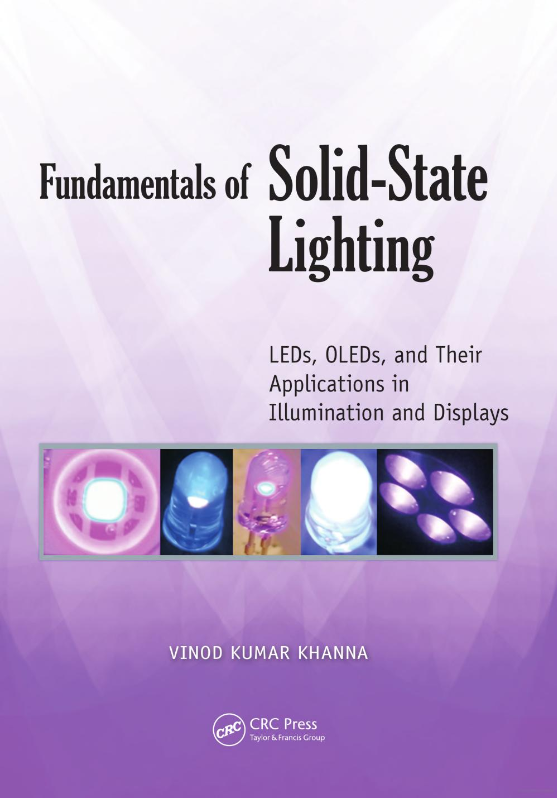
Fundamentals of Solid-State Lighting: LEDs, OLEDs, and Their Applications in Illumination and Displays PDF - Vinod Kumar Khanna
Vinod Kumar Khanna • Communications Engineering • 59 Pages
(0)
Author
Vinod Kumar KhannaCategory
fieldsSection
Number Of Downloads
73
Number Of Reads
131
File Size
1.65 MB
Views
1,198
Quate
Review
Save
Share
Book Description
Fundamentals of Solid-State Lighting by Vinod Kumar Khanna
Fundamentals of Solid-State Lighting: LEDs, OLEDs, and Their Applications in Illumination and Displays by Vinod Kumar Khanna is a comprehensive and technically detailed reference that explores the rapidly evolving world of solid-state lighting technologies. Published by CRC Press, this authoritative book provides an in-depth examination of LEDs, OLEDs, semiconductor lighting systems, and their growing role in modern illumination and display applications. The book is widely recognized as an important resource for engineers, researchers, students, and professionals involved in electronics, photonics, materials science, electrical engineering, and display technologies. (embs.org)
Solid-state lighting has transformed the global lighting industry by offering energy-efficient, durable, and environmentally friendly alternatives to traditional incandescent and fluorescent lighting systems. This book carefully explains the scientific principles behind these technologies while also connecting theory with practical engineering applications. Readers are introduced to the foundations of light generation in semiconductors, the structure and operation of inorganic LEDs, the chemistry and physics of OLEDs, thermal management challenges, device fabrication techniques, and smart lighting solutions used in modern industries. (Better World Books)
A Complete Guide to LEDs and OLED Technologies
One of the strongest aspects of this book is its broad yet highly organized coverage of the entire field of solid-state lighting. The text begins with the historical evolution of lighting technologies, allowing readers to understand how lighting systems progressed from traditional lamps to modern semiconductor-based illumination. It then develops a strong theoretical foundation in optics, photometry, radiometry, and color science before moving into advanced LED engineering concepts. (embs.org)
The book explores key technical concepts including:
- Semiconductor physics and electroluminescence
- Homojunction and heterojunction LEDs
- Surface-emitting and edge-emitting LEDs
- Light extraction efficiency
- LED packaging technologies
- Thermal management and reliability
- High-brightness LEDs (HBLEDs)
- White light generation techniques
- Phosphor materials for LEDs
- OLED structures and polymer LEDs
- Smart lighting systems and controls
- LED driving circuits and power electronics
These topics are presented with a balance of theoretical explanation and engineering practicality, making the book valuable both as an academic textbook and as a professional reference guide.
Strong Focus on Practical Applications
Unlike many purely theoretical semiconductor books, this work dedicates significant attention to real-world applications of LED and OLED technologies. The author discusses how solid-state lighting is used in:
- General indoor and outdoor illumination
- Automotive lighting systems
- Street lighting
- Display panels and digital screens
- AMOLED and PMOLED displays
- Flexible OLED technologies
- Medical and biomedical lighting
Optical communications
Smart and adaptive lighting systems
Horticultural lighting applications
This application-oriented approach makes the book especially useful for engineers and technology professionals seeking to understand not only how LEDs work, but also how they are integrated into modern commercial and industrial products. (embs.org)
Detailed Coverage of OLED Display Technology
The sections devoted to OLED technology are particularly valuable because college-level and professional resources on OLEDs are relatively limited compared to traditional semiconductor textbooks. The book explains the materials, device architectures, emission mechanisms, and display technologies behind OLED systems in a clear and methodical manner. Readers gain insight into both small-molecule OLEDs and polymer LEDs, including their advantages, limitations, manufacturing approaches, and future potential. (embs.org)
The discussion of OLED displays is highly relevant for readers interested in modern televisions, smartphones, wearable electronics, and flexible display technologies. Concepts such as active-matrix OLEDs (AMOLEDs), passive-matrix OLEDs (PMOLEDs), thin-film transistor backplanes, and RGB stacking methods are explained with technical depth suitable for advanced learners and industry professionals.
Engineering, Manufacturing, and Reliability Analysis
Another major strength of the book is its engineering-oriented treatment of manufacturing and reliability issues. Many lighting books focus mainly on optical performance, but this text also emphasizes production methods, fabrication technologies, packaging systems, and device reliability.
The author discusses:
Semiconductor material selection
Epitaxial growth techniques
Fabrication processes
Packaging methods
Heat dissipation challenges
Performance metrics
Failure mechanisms
Device lifetime considerations
This makes the book especially relevant for readers involved in semiconductor manufacturing, electronics packaging, optoelectronics design, and industrial product development. Thermal management and reliability analysis are presented as critical factors in determining the performance and lifespan of LED systems, which is essential knowledge for practical engineering work. (Better World Books)
Ideal Audience for This Book
This book is designed primarily for readers with technical or engineering backgrounds. It is especially suitable for:
Electrical engineering students
Electronics and communication engineers
Semiconductor researchers
- Display technology specialists
- Optoelectronics professionals
- Materials science researchers
Lighting designers and architects
Graduate students in photonics and applied physics
Although the book includes advanced technical material, its structured presentation and broad coverage also make it accessible to motivated readers seeking a deeper understanding of modern lighting technologies. Engineers transitioning into the LED or display industry will find it particularly useful as a foundational reference.
Why This Book Remains Important
Even years after publication, Fundamentals of Solid-State Lighting remains highly relevant because LED and OLED technologies continue to dominate innovation in energy-efficient lighting and display systems. The global shift toward sustainable lighting solutions, smart cities, low-power electronics, and advanced displays has only increased the importance of understanding solid-state lighting technologies.
The book offers readers a rare combination of semiconductor theory, practical engineering, display technology, manufacturing processes, and application-driven analysis within a single volume. Its multidisciplinary approach makes it valuable across academic research, industrial development, and professional engineering education. (Routledge)
An Essential Reference for Modern Lighting and Display Engineering
For anyone interested in LED engineering, OLED displays, semiconductor lighting systems, energy-efficient illumination, or advanced display technologies, this book provides a detailed and carefully structured learning experience. Its extensive coverage of both inorganic and organic lighting technologies, combined with practical insights into manufacturing and applications, makes it a significant reference work in the field of solid-state lighting.
Whether used as a university textbook, a professional engineering guide, or a technical reference for research and development, Fundamentals of Solid-State Lighting: LEDs, OLEDs, and Their Applications in Illumination and Displays stands as an authoritative resource for understanding one of the most important technological transformations in modern electronics and illumination systems.
Vinod Kumar Khanna
Vinod Kumar Khanna born on November 25, 1952 at Lucknow, Uttar Pradesh, India, is an Emeritus Scientist at CSIR-Central Electronics Engineering Research Institute, Pilani, Rajasthan, India, and Emeritus Professor, AcSIR (Academy of Scientific and Innovative Research), India. He is former Chief Scientist and Head, MEMS and Microsensors Group, CSIR-CEERI, Pilani, and Professor, AcSIR. During his service tenure of more than 34 years at CSIR-CEERI, starting from April 1980, he worked on various research and development projects on power semi- conductors devices (high-current and high-voltage rectifier, high-voltage TV deflection transistor, power Darlington transistor, fast switching thyristor, power DMOSFET and IGBT), PIN diode neutron dosimeter and PMOSFET gamma ray dosimeter, ion-sensitive field-effect transistor (ISFET), microheater-embedded gas sensor, capacitive MEMS ultrasonic transducer (CMUT), and other MEMS devices. His research interests were micro- and nanosensors, and power semiconductor devices. From 1977 to 1979, he was Research Assistant in the Physics Department, Lucknow University. Dr. Khanna’s deputations abroad include Technische Universität Darmstadt, Germany, 1999; Kurt-Schwabe-Institut für Mess- und Sensortechnik e.V., Meinsberg, Germany, 2008; and Institute of Chemical Physics, Novosibirsk, Russia, 2009. He also participated and presented research papers at IEEE-IAS Annual Meeting, Denver, Colorado, USA, 1986. Dr. Khanna received his M.Sc. degree in Physics with specialization in Electronics from the University of Lucknow in 1975, and Ph.D. degree in Physics from Kurukshetra University, Kurukshetra, Haryana, in 1988 for his work on thin-film aluminum oxide humidity sensor. A fellow of the Institution of Electronics and Telecommunication Engineers (IETE), India, he is a life member of Indian Physics Association (IPA), Semiconductor Society (SSI), India and Indo-French Technical Association. Dr. Khanna has published nine books, six chapters in edited books, and 181 research papers in national/international journals and conference proceedings; he holds two US and two Indian patents.
Earn Rewards While Reading!
Every 10 pages you read and spent 30 seconds on every page, earns you 5 reward points! Keep reading to unlock achievements and exclusive benefits.
Read
Rate Now
5 Stars
4 Stars
3 Stars
2 Stars
1 Stars
Fundamentals of Solid-State Lighting: LEDs, OLEDs, and Their Applications in Illumination and Displays Quotes
Top Rated
Latest
Quate
Be the first to leave a quote and earn 10 points
instead of 3
Other books by Vinod Kumar Khanna
'%20/%3e%3c/svg%3e "Integrated Nanoelectronics: Nanoscale CMOS, Post-CMOS and Allied Nanotechnologies")
Vinod Kumar Khanna.
Nanotechnology
(0)
1207
English
Vinod Kumar Khanna.
Communications Engineering
(0)
1005
English
Vinod Kumar Khanna.
Communications Engineering
(0)
914
English
Other books like Fundamentals of Solid-State Lighting: LEDs, OLEDs, and Their Applications in Illumination and Displays
Wendell Odom.
Communications Engineering
(0)
2525
English
2988
English
2432
English
Comments
Be the first to leave a comment and earn 5 points
instead of 3