

The source of the book
This book is published for the public benefit under a Creative Commons license, or with the permission of the author or publisher. If you have any objections to its publication, please contact us.
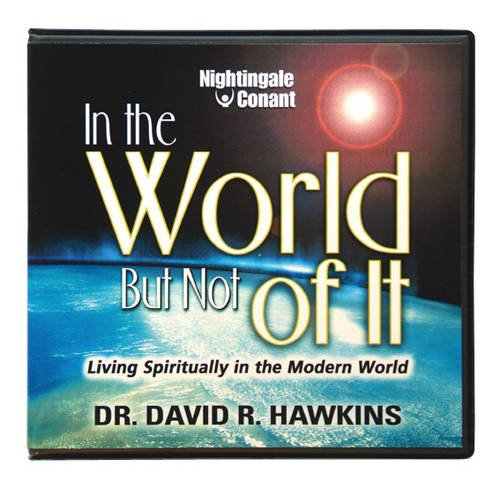
In the World, but not of it PDF - David R. Hawkins
David R. Hawkins • Human Development • 85 Pages
(0)
Quate
Review
Save
Share
Book Description
In the World, But Not of It by David R. Hawkins, M.D., Ph.D. is a concise and deeply focused work of practical spirituality, written for readers who want to live with greater peace, compassion, and inner steadiness while still participating fully in everyday life. With the subtitle Transforming Everyday Experience into a Spiritual Path, the book presents Hawkins’s central message in a direct and accessible form: spiritual growth is not limited to retreats, meditation rooms, or isolated moments of insight, but can unfold through ordinary choices, relationships, responsibilities, and responses to the modern world. The book was published by Hay House and is listed in the mind, body, and spirit category.
A Spiritual Guide for Modern Life
At the heart of In the World, But Not of It is the question many sincere seekers face: how can a person remain inwardly devoted, loving, and conscious while living in a fast-moving, technologically advanced, and often stressful world? Hawkins approaches this question with the clarity and warmth that characterize much of his work, offering guidance for those who want spiritual awareness to become part of daily living rather than a separate activity. The book is especially relevant for readers interested in consciousness, surrender, inner peace, nonduality, spiritual awakening, and the transformation of ordinary experience.
Rather than encouraging withdrawal from life, Hawkins points toward a way of being in which daily circumstances become opportunities for awareness. Work, family, change, responsibility, uncertainty, and even frustration can become part of the spiritual path when met with humility, accountability, and willingness. This makes the book valuable for readers who are searching for a grounded form of spiritual practice in everyday life, one that does not depend on dramatic experiences but on a steady shift in intention and perception.
Turning Ordinary Experience into Spiritual Practice
One of the strongest themes of the book is the movement from occasional spiritual experience toward a more stable way of living. Hawkins addresses why certain spiritual experiences may feel powerful yet remain temporary, and he emphasizes the importance of integrating spiritual understanding into normal activities. The book, based on an audio program of the same name, explores how ordinary life can become a field of practice, including responsibility for choices, conscious participation in the world, and the cultivation of love, grace, and compassion.
This focus gives In the World, But Not of It a practical tone. It is not merely a philosophical reflection on detachment or enlightenment; it is a guide to applying spiritual principles where they are most tested: in reactions, habits, priorities, and relationships. Readers familiar with Hawkins’s teachings will recognize his emphasis on the elevation of consciousness, the release of egoic resistance, and the importance of inner alignment. New readers may find this book a clear entry point into his broader spiritual vocabulary because it concentrates on recognizable experiences rather than abstract theory alone.
Themes of Consciousness, Responsibility, and Inner Freedom
David R. Hawkins is widely associated with teachings on levels of consciousness, surrender, devotion, and the distinction between the ego’s viewpoint and a higher spiritual perspective. In this book, those themes are expressed through the practical challenge of living as a “citizen of the world” without becoming inwardly dominated by worldly fear, pressure, conflict, or distraction. Hawkins presents spiritual maturity not as an escape from responsibility, but as a deeper form of responsibility—one rooted in awareness, compassion, and accountability.
The phrase “in the world, but not of it” captures this balance. To be “in the world” is to participate in life, fulfill obligations, care for others, and respond to circumstances. To be “not of it” is to avoid being defined by fear, status, conflict, material attachment, or collective negativity. The result is not indifference, but freedom: the capacity to act with greater love and clarity because one is less controlled by anxiety, resentment, or the need to dominate outcomes.
Who This Book Is For
In the World, But Not of It is well suited for readers of spiritual self-help, consciousness studies, mindfulness, nondual spirituality, devotional spirituality, and personal transformation. It will especially appeal to those who appreciate teachings that combine spiritual depth with practical application. Readers who have enjoyed Hawkins’s works such as Letting Go, Power vs. Force, or his books on consciousness may find this volume a compact continuation of his central concerns: how to transcend lower states of mind, live from a more loving inner orientation, and allow daily life to become a path of awakening.
The book may also be meaningful for readers who feel overwhelmed by change, technology, stress, or the pace of modern life. Hawkins’s approach does not deny the challenges of contemporary living; instead, it reframes them as opportunities to practice steadiness, discernment, and surrender. For anyone asking how to stay spiritually centered without rejecting the world, this book offers a thoughtful and encouraging answer.
About David R. Hawkins
David R. Hawkins, M.D., Ph.D. was an author, lecturer, physician, clinician, and researcher known for his work on consciousness and spiritual development. Penguin’s author information describes him as director of the Institute for Spiritual Research, Inc., founder of the Path of Devotional Nonduality, and a pioneering researcher in the field of consciousness. His writing often blends psychology, spirituality, philosophy, and devotional insight, making his books relevant to readers seeking both inner transformation and a coherent framework for understanding spiritual evolution.
A Concise Book with a Lasting Spiritual Message
Although In the World, But Not of It is a short work, its subject is expansive: how to live with awakened intention amid the demands of ordinary life. Hawkins invites the reader to see every experience as part of the path, not only moments that appear peaceful, sacred, or inspiring. In this sense, the book offers a vision of spirituality that is both elevated and practical, reminding readers that consciousness is shaped through the way one meets the present moment.
For readers seeking a David R. Hawkins book on practical spirituality, higher consciousness, and living spiritually in the modern world, In the World, But Not of It offers a clear and contemplative guide. It encourages a life centered in love, grace, compassion, and responsibility—an approach to spiritual growth that remains engaged with the world while no longer being inwardly ruled by it.
David R. Hawkins
Dr. David R. Hawkins, born David Ramon Hawkins, was an American psychiatrist, physician, researcher, lecturer, spiritual teacher, and bestselling author whose work became widely associated with consciousness studies, emotional healing, devotional spirituality, and practical inner transformation. Born in Milwaukee, Wisconsin, on June 3, 1927, and deceased in Sedona, Arizona, on September 19, 2012, Hawkins built a career that moved from clinical psychiatry into a broader body of spiritual and philosophical writing. His official biography identifies him as Medical Director of the North Nassau Mental Health Center from 1956 to 1980 and Director of Research at Brunswick Hospital from 1968 to 1979, details that help explain the clinical language that appears throughout his books on suffering, recovery, surrender, addiction, fear, guilt, anger, and the search for peace. In 1973, he co-authored Orthomolecular Psychiatry with Nobel Prize-winning chemist Linus Pauling, a collaboration that placed him within a debated but historically significant area of psychiatry, nutrition, and biological approaches to mental health. As an author, Hawkins is best known for Power vs. Force: The Hidden Determinants of Human Behavior, Letting Go: The Pathway of Surrender, The Eye of the I, I: Reality and Subjectivity, Truth vs. Falsehood, Transcending the Levels of Consciousness, and Healing and Recovery. These works made him especially visible among readers searching for books on consciousness, spiritual awakening, emotional release, self-inquiry, nonduality, meditation, and the psychology of transformation. In Power vs. Force, Hawkins introduced the framework he called the Map of Consciousness, a symbolic and spiritual model that organizes human attitudes and emotions from states such as shame, fear, anger, and pride toward courage, acceptance, love, joy, peace, and enlightenment. The model should be understood as part of Hawkins’s own spiritual-philosophical system rather than as a substitute for mainstream medical, psychological, or psychiatric treatment. His later and highly popular book Letting Go presents a “surrender” approach to emotional life, encouraging readers to observe, allow, and release inner resistance rather than suppressing or dramatizing difficult feelings. This emphasis on surrender made Hawkins especially influential among readers interested in emotional freedom, mindfulness, forgiveness, recovery, and spiritual self-help. His style is direct, devotional, and often didactic: he writes as a physician familiar with pain, as a contemplative teacher concerned with the ego, and as a spiritual author attempting to connect everyday human struggle with questions of truth, compassion, and ultimate reality. His official biography also notes that he founded the Institute for Spiritual Research in 1983 and the Path of Devotional Nonduality in 2003, and that he lectured at universities, spiritual centers, and public forums. For a book website, David R. Hawkins can be presented as a major modern author in the fields of spirituality, consciousness, and inner healing, particularly suited to readers seeking thoughtful works on letting go, personal transformation, recovery, devotion, awareness, and the movement from emotional suffering toward a more peaceful and meaningful life.
Earn Rewards While Reading!
Every 10 pages you read and spent 30 seconds on every page, earns you 5 reward points! Keep reading to unlock achievements and exclusive benefits.
Read
Rate Now
5 Stars
4 Stars
3 Stars
2 Stars
1 Stars
In the World, but not of it Quotes
Top Rated
Latest
Quate
Be the first to leave a quote and earn 10 points
instead of 3
Other books by David R. Hawkins
'%20/%3e%3c/svg%3e "The Eye of the I: From Which Nothing is Hidden")
David R. Hawkins.
Human Development
(0)
6504
English
Comments
Be the first to leave a comment and earn 5 points
instead of 3