

The source of the book
This book is published for the public benefit under a Creative Commons license, or with the permission of the author or publisher. If you have any objections to its publication, please contact us.
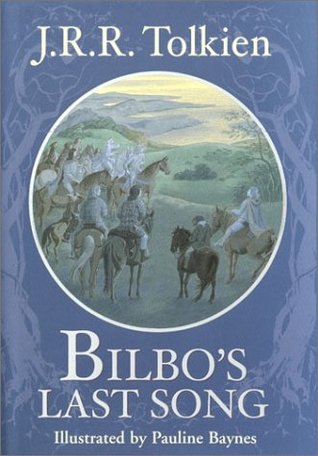
Bilbo’s Last Song PDF - J. R. R. Tolkien
J. R. R. Tolkien • short stories • 73 Pages
(0)
Quate
Review
Save
Share
Book Description
Bilbo’s Last Song by J. R. R. Tolkien
Bilbo’s Last Song is a deeply reflective and emotionally resonant poem associated with the world of Middle-earth, offering readers a quiet, poetic farewell from one of the most beloved characters in fantasy literature, Bilbo Baggins. Though brief in length, this work carries a powerful sense of closure, memory, and transition, capturing the final journey of Bilbo as he prepares to leave the familiar lands of the Shire and sail beyond the mortal world toward the Undying Lands. It is a meditation on aging, peace, and the beauty of letting go, written in a style that reflects the lyrical and timeless tone characteristic of Tolkien’s legendarium.
Originally published posthumously and beautifully illustrated by Pauline Baynes, Bilbo’s Last Song stands apart from the larger narrative structure of The Lord of the Rings and The Hobbit, yet it feels intimately connected to both. It is not a tale of battles or quests, but rather a gentle epilogue to a life filled with adventure, courage, and unexpected heroism. The poem is often interpreted as Bilbo’s final farewell not only to Middle-earth but also to the reader, offering a soft emotional landing after years of epic storytelling.
At its core, the poem reflects themes of departure and transcendence. Bilbo Baggins, once an unlikely adventurer who stepped far beyond the comforts of Bag End, now reaches the final stage of his journey. The tone is calm, contemplative, and slightly melancholic, yet it is also infused with acceptance and grace. Rather than focusing on loss in a painful sense, the poem emphasizes completion and fulfillment. Bilbo’s journey is not ending in despair but concluding in harmony, as he sails toward a place of light and restoration.
The language of Bilbo’s Last Song is simple yet evocative, designed to echo the traditional songs and poems found throughout Tolkien’s fictional world. It carries the cadence of folk verse, making it feel as though it could have been sung in the halls of Rivendell or whispered among the Elves at the Grey Havens. This musical quality enhances the emotional depth of the work, turning it into something that feels both ancient and timeless.
Readers familiar with Tolkien’s broader mythology will recognize the emotional significance of the Grey Havens, the port from which Elves—and eventually certain mortals like Bilbo—sail westward into the unknown lands beyond Middle-earth. This setting is not merely geographical but symbolic, representing the transition from the known world into something beyond mortal understanding. In this context, Bilbo’s song becomes a final reflection on life’s journey, friendship, and the quiet dignity of endings.
The illustrations by Pauline Baynes add another layer of meaning to the poem, visually expanding its emotional tone. Her artwork captures the gentle beauty of the voyage, the serene atmosphere of the sea, and the wistful expression of farewell. Together, text and image create a unified artistic experience that deepens the reader’s emotional engagement with Bilbo’s final moments in Middle-earth.
For readers searching for a short yet meaningful Tolkien work, Bilbo’s Last Song offers a unique experience. Unlike longer narratives filled with complex lore and extensive world-building, this piece is accessible and immediate, making it suitable for both longtime fans of Middle-earth and newcomers who may be discovering Tolkien’s world for the first time. It serves as a gentle introduction to the emotional and philosophical depth that underlies Tolkien’s writing.
One of the most compelling aspects of the poem is its treatment of time and memory. Bilbo reflects not only on the physical journey ahead but also on the life he has lived, the companions he has met, and the experiences that have shaped him. This reflective quality resonates strongly with readers who appreciate literary works that explore aging, legacy, and the passage of time. It invites contemplation rather than action, encouraging readers to pause and consider the meaning of their own journeys.
Despite its brevity, Bilbo’s Last Song carries a universal message: that endings can be peaceful, meaningful, and even beautiful. It gently challenges the fear often associated with farewell, replacing it with a sense of completion and acceptance. This makes the poem particularly appealing to readers who enjoy philosophical or emotionally rich literature, as well as those drawn to the softer, more introspective side of fantasy storytelling.
In the broader context of Tolkien’s works, this poem functions almost like a closing note—a final echo from a world that has captivated readers for generations. It does not seek to expand the narrative but to soften its conclusion, offering a sense of closure that feels both personal and universal. Bilbo’s voice, though fictional, becomes a symbol of every traveler who has reached the end of their path and looks back with gratitude rather than regret.
Ultimately, Bilbo’s Last Song is a quiet masterpiece of reflection and farewell. It distills the essence of Tolkien’s storytelling into a few carefully chosen lines, blending mythology, emotion, and poetic simplicity. For readers who have journeyed through the vast landscapes of Middle-earth, this poem feels like a final hand extended in friendship before the last ship sails beyond the horizon.
J. R. R. Tolkien
John Ronald Reuel Tolkien (1892-1973) was an English writer, poet, and philologist best known for his works of high fantasy, including The Hobbit, The Lord of the Rings, and The Silmarillion. He was born in South Africa and raised in England, where he studied at Oxford University and later became a professor of Anglo-Saxon and English at the same institution.
Tolkien began writing stories as a child, and his love of language and mythology would later influence his fictional works. His first published work was a poem called "Goblin Feet" in the literary magazine Oxford Poetry in 1915. During World War I, Tolkien served in the British Army and later returned to academia.
In the 1930s, Tolkien began working on The Hobbit, a children's book that would eventually become a classic of fantasy literature. Published in 1937, The Hobbit tells the story of a hobbit named Bilbo Baggins who embarks on a quest to help a group of dwarves reclaim their treasure from a dragon.
Tolkien's next major work was The Lord of the Rings, a trilogy published in the mid-1950s that continues the story of Middle-earth, the setting of The Hobbit. The books follow the quest of hobbit Frodo Baggins to destroy the One Ring, a powerful artifact created by the dark lord Sauron to conquer Middle-earth.
Tolkien also worked on other stories set in Middle-earth, including The Silmarillion, which tells the history of the world and the creation of the first elves, and various unfinished tales collected in Unfinished Tales of Númenor and Middle-earth.
Tolkien's work has had a significant impact on the fantasy genre, with many authors citing him as a major influence. The popularity of his works has also led to adaptations in other media, including films, television series, and video games.
In addition to his writing, Tolkien was a respected scholar of language and literature, with a particular interest in Old English and Norse mythology. His academic work includes editions of medieval texts and a seminal lecture series on Beowulf, which has been published as a book.
Earn Rewards While Reading!
Every 10 pages you read and spent 30 seconds on every page, earns you 5 reward points! Keep reading to unlock achievements and exclusive benefits.
Read
Rate Now
5 Stars
4 Stars
3 Stars
2 Stars
1 Stars
Bilbo’s Last Song Quotes
Top Rated
Latest
Quate
Be the first to leave a quote and earn 10 points
instead of 3
'%20/%3e%3c/svg%3e "The Children of Hurin")
Comments
Be the first to leave a comment and earn 5 points
instead of 3