

The source of the book
This book is published for the public benefit under a Creative Commons license, or with the permission of the author or publisher. If you have any objections to its publication, please contact us.
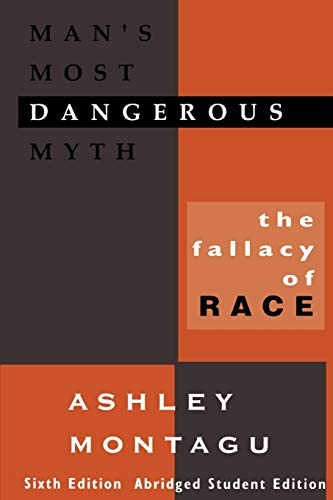
Man's Most Dangerous Myth: The Fallacy of Race PDF - Ashley Montagu
Ashley Montagu • Anthropology • 680 Pages
(0)
Author
Ashley MontaguCategory
Social sciencesSection
Number Of Downloads
62
Number Of Reads
215
File Size
3.06 MB
Views
1,407
Quate
Review
Save
Share
Book Description
Man’s Most Dangerous Myth: The Fallacy of Race by Ashley Montagu
Man’s Most Dangerous Myth: The Fallacy of Race by Ashley Montagu is a landmark work in anthropology, race studies, social science, and human rights thought. First published in 1942 by Columbia University Press, the book appeared at a moment when racial ideology had become one of the most destructive political forces of the modern world. A contemporary bibliographic record for the original edition lists it as Man’s Most Dangerous Myth; The Fallacy of Race by M. F. Ashley Montagu, published in New York by Columbia University Press in 1942.
A Powerful Challenge to the Idea of Race
At the heart of Man’s Most Dangerous Myth is Montagu’s argument that “race,” as commonly used to classify human beings into fixed and unequal biological groups, is a misleading and dangerous myth. Rather than treating racial categories as natural divisions that determine intelligence, character, culture, or moral worth, Montagu examines how such ideas are created, defended, and used by societies. The book became known for breaking the assumed link between genetics and culture and for arguing that race is largely a social construction rather than a meaningful basis for deep biological hierarchy among people.
This makes the book essential reading for anyone interested in the fallacy of race, racism, anthropology, race relations, social construction, human equality, and the history of racial thought. Montagu does not simply reject racist conclusions; he questions the very framework that allowed those conclusions to appear scientific. His work asks readers to look carefully at how language, politics, prejudice, and selective science can turn human difference into a rigid system of domination.
Race, Science, and the Misuse of Biology
One of the most important features of Man’s Most Dangerous Myth: The Fallacy of Race is its critique of biological determinism. Montagu examines how claims about inherited racial character, intelligence, aggression, creativity, and civilization have often depended on weak reasoning, cultural bias, and the confusion of social conditions with biological facts. Instead of accepting race as a clear scientific category, he analyzes how physical traits such as skin color, ancestry, and appearance have been exaggerated into broad claims about human worth.
For readers searching for a serious book on race and biology, Montagu’s argument remains significant because it shows how scientific language can be misused when social prejudice guides interpretation. The book is especially valuable for students of anthropology, sociology, history, political science, ethnic studies, and critical race studies who want to understand how ideas of racial hierarchy were challenged from within twentieth-century scholarship. It also speaks to general readers who want to understand why race remains socially powerful even when its biological meaning is deeply contested.
A Book Written Against a Dangerous Historical Background
The historical setting of the book is central to its force. Man’s Most Dangerous Myth was first published during the Second World War, in a period marked by Nazi racial ideology and legally enforced racial segregation in the United States. Later publisher descriptions emphasize that the book appeared when Nazism was flourishing, when African Americans were subjected to segregation, and when many people still treated race as a determinant of intelligence and character.
This background gives Montagu’s work a moral urgency. He was not writing about race as an abstract academic topic detached from real life. He was writing about an idea that had justified slavery, colonialism, segregation, anti-Semitism, exclusion, war, and mass violence. By calling race “man’s most dangerous myth,” Montagu identifies racial thinking as more than an error; he presents it as a social weapon, a false belief capable of organizing fear, hatred, and inequality on a massive scale.
The Social Construction of Race
A central reason the book remains important is its attention to the social construction of race. Montagu argues that racial categories are not neutral descriptions of humanity but social classifications shaped by history, politics, economics, and power. This does not mean that human beings have no physical variation. Rather, it means that the meanings attached to those variations are created by societies, and those meanings can become tools of exclusion, oppression, and inequality.
This distinction is crucial for readers trying to understand modern conversations about racism, ethnicity, identity, racial categories, and social inequality. Montagu’s work helps explain why race can be scientifically unstable yet socially real in its consequences. People may be classified by systems they did not create, and those classifications can affect law, opportunity, education, health, housing, employment, and social belonging. In this sense, the book remains useful because it separates the biological question from the social reality of racism.
Themes and Scope of the Book
The scope of Man’s Most Dangerous Myth is broad and ambitious. Later edition records and tables of contents show that Montagu addresses topics such as the origin of the concept of race, older anthropological ideas about race, genetics, biological facts, natural selection, race and society, race and culture, racism and social action, intelligence, IQ, and race. The sixth edition is listed as a 1997 AltaMira Press publication of 699 pages, with subjects including Race and Race relations.
These topics make the book more than a single argument against prejudice. It is a wide-ranging investigation into how racial ideas are formed, how they persist, and how they can be challenged. Montagu moves between science and society, showing that the problem of race cannot be understood only through biology or only through politics. It requires attention to history, culture, psychology, education, and social institutions.
Why Ashley Montagu’s Argument Still Matters
Although written in the twentieth century, Man’s Most Dangerous Myth: The Fallacy of Race continues to speak to ongoing debates about race, identity, inequality, and public policy. Later descriptions of the revised editions note that the book’s subsequent versions traced changing ideas about race and race relations across the twentieth century, and that the sixth edition addressed topics such as The Bell Curve, IQ testing, ethnic cleansing, and contemporary race relations.
For modern readers, this continuing revision history is important. It shows that Montagu’s argument was not limited to the conditions of 1942. The myth of race changes form over time. It may appear as old-fashioned racial hierarchy, as pseudoscientific claims about intelligence, as cultural essentialism, or as political rhetoric about national, ethnic, or religious identity. Montagu’s work gives readers a framework for recognizing these patterns and questioning the assumptions behind them.
A Valuable Book for Students and General Readers
Man’s Most Dangerous Myth is especially useful for readers looking for a foundational text in anthropology, anti-racism, race relations, human variation, and the critique of racial ideology. Students will find it valuable as a historical document in the development of modern thinking about race. Teachers and researchers may find it useful for understanding how mid-twentieth-century scholars challenged scientific racism. General readers may appreciate the book for its clear moral purpose: to expose the harm caused when human beings are divided into supposedly superior and inferior types.
The book is also relevant for readers interested in how ideas become powerful. Montagu shows that dangerous myths do not survive only because they are true; they often survive because they are useful to institutions, political movements, and social hierarchies. The myth of race has been used to explain inequality as natural, to disguise injustice as science, and to turn cultural difference into permanent human ranking. By challenging that myth, Montagu invites readers to think more carefully about evidence, language, and responsibility.
Reading Experience and Intellectual Value
The reading experience of Man’s Most Dangerous Myth: The Fallacy of Race is serious, challenging, and intellectually engaged. It is not a light popular treatment of prejudice, but a sustained examination of one of the most influential and harmful ideas in modern history. Montagu’s style combines scholarly argument with moral conviction, making the book suitable for readers who want depth rather than simplification.
Because the book has passed through several editions, readers may encounter versions that differ in length, organization, and updated material. A 1974 edition listed by the Internet Archive identifies the book under the topics Race and Race relations, while the later 1997 edition expands the discussion into a large revised work. This edition history reflects the lasting relevance of the subject and the author’s continued effort to respond to changing debates about race.
A Classic Work on Racism, Human Difference, and Equality
Man’s Most Dangerous Myth: The Fallacy of Race by Ashley Montagu remains a classic because it confronts a belief system that has shaped history, politics, science, and everyday life. Its central message is that racial categories, when treated as natural hierarchies of human value, become instruments of distortion and harm. Montagu’s book challenges readers to separate human biological variation from racist mythology, and to recognize the social processes that turn difference into inequality.
For anyone searching for a major book on the fallacy of race, racial myths, scientific racism, anthropology of race, race relations, anti-racist thought, and the social construction of race, this work offers a historically important and intellectually powerful reading experience. It is a book about science, but also about justice. It is a book about classification, but also about human dignity. Above all, it is a warning against one of the most destructive myths human societies have ever created: the belief that race can define the worth, intelligence, character, or destiny of a human being.
Ashley Montagu
Ashley Montagu was a British-born American anthropologist, author, educator, and public intellectual whose work helped shape twentieth-century conversations about race, human development, gender, touch, aggression, and the social foundations of personality. Born Israel Ehrenberg in London in 1905 and later known professionally as Ashley Montagu, he became widely recognized for bringing anthropology beyond the university and into public debate, using science as a tool to challenge prejudice and defend human dignity. His career was rooted in physical anthropology, but his writing consistently moved across disciplinary boundaries, drawing on biology, psychology, sociology, education, medicine, philosophy, and cultural history. Montagu’s most influential book, Man’s Most Dangerous Myth: The Fallacy of Race, remains closely associated with his lifelong opposition to racism and racial determinism. In that work, and in many essays and lectures, he argued that “race” as commonly used in politics and popular culture was a misleading and harmful category, one that had been used to rationalize inequality rather than to explain human diversity accurately. His approach reflected a broader humanist conviction: human beings are not reducible to inherited labels, and scientific language must not be allowed to disguise social injustice as natural fact. Montagu also attracted wide attention for The Natural Superiority of Women, a provocative book that questioned entrenched assumptions about sex, gender, strength, intelligence, and social roles. Whether readers agreed with every argument or not, the book demonstrated his willingness to confront inherited beliefs and to use accessible prose to push public conversation in new directions. Among his other notable works are Touching: The Human Significance of the Skin, The Elephant Man: A Study in Human Dignity, The Direction of Human Development, and writings on childhood, love, aging, aggression, and cooperation. A recurring theme across these books is the idea that human beings are profoundly shaped by care, affection, social learning, and cultural environment. For Montagu, the infant’s need for touch, the child’s need for nurture, and the adult’s need for meaningful connection were not sentimental topics; they were central facts about human biology and civilization. His prose combined scholarly range with direct moral urgency, making his books useful for students, researchers, teachers, and general readers interested in anthropology, social justice, psychology, and the history of ideas. Montagu studied in Britain and the United States and engaged with major currents in modern anthropology, especially those that resisted simplistic biological explanations of human difference. He taught, lectured, wrote prolifically, and became a familiar public voice in mid-century intellectual life, appearing in media discussions and contributing to debates on education, family life, race relations, and human nature. His reputation rests not only on his academic knowledge but also on his ability to translate that knowledge into arguments that mattered outside the academy. He wrote at a time when the misuse of science had helped justify colonialism, segregation, eugenics, and fascism, and he insisted that responsible science must expose rather than reinforce such myths. Ashley Montagu’s legacy is therefore both scholarly and ethical. He remains an important author for readers seeking clear, humane, and historically significant writing about what it means to be human, how societies create difference, and why compassion, learning, and cooperation are essential to any serious understanding of human life.
Earn Rewards While Reading!
Every 10 pages you read and spent 30 seconds on every page, earns you 5 reward points! Keep reading to unlock achievements and exclusive benefits.
Read
Rate Now
5 Stars
4 Stars
3 Stars
2 Stars
1 Stars
Man's Most Dangerous Myth: The Fallacy of Race Quotes
Top Rated
Latest
Quate
Be the first to leave a quote and earn 10 points
instead of 3
Other books by Ashley Montagu
Other books like Man's Most Dangerous Myth: The Fallacy of Race
'%20/%3e%3c/svg%3e "Cultural Anthropology: Global Forces, Local Lives, 3rd ed.")
2214
English
Comments
Be the first to leave a comment and earn 5 points
instead of 3