
Newly released
This book is new and will be uploaded as soon as it becomes available to us and if we secure the necessary publishing rights.
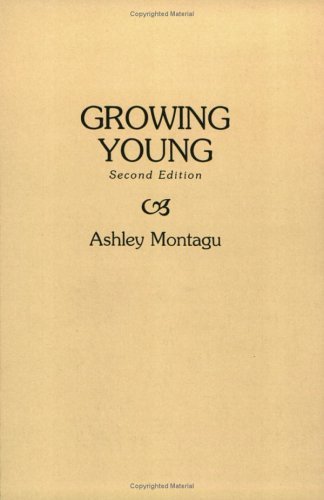
Growing Young PDF - Ashley Montagu
Ashley Montagu • Human Development
(0)
Quate
Review
Save
Share
Book Description
In this new, revised edition of his landmark book, Montagu compels us to reevaluate the way we think about growth and development, in all its phases, throughout life. Humans are designed to grow and develop their childlike qualities, and not to become the ossified adults prescribed by society. Montagu demonstrates how our culture, schools, and families are in conspiracy against such childlike traits as the need to love, to learn, to wonder, to know, to explore, to think, to experiment, to be imaginative, creative and curious, to sing, dance, or play. He also reveals the many links between physical and mental aging and tells how to prevent psychosclerosis, the hardening of the mind, so that we can die young--as late as possible. The best statement ever written on the most important, neglected theme of human life and evolution. Stephen Jay Gould, Harvard University
In this new, revised edition of his landmark book, Montagu compels us to reevaluate the way we think about growth and development, in all its phases, throughout life. Humans are designed to grow and develop their childlike qualities, and not to become the ossified adults prescribed by society. Montagu demonstrates how our culture, schools, and families are in conspiracy against such childlike traits as the need to love, to learn, to wonder, to know, to explore, to think, to experiment, to be imaginative, creative and curious, to sing, dance, or play. He also reveals the many links between physical and mental aging and tells how to prevent psychosclerosis, the hardening of the mind, so that we can die young--as late as possible.
Ashley Montagu
Ashley Montagu was a British-born American anthropologist, author, educator, and public intellectual whose work helped shape twentieth-century conversations about race, human development, gender, touch, aggression, and the social foundations of personality. Born Israel Ehrenberg in London in 1905 and later known professionally as Ashley Montagu, he became widely recognized for bringing anthropology beyond the university and into public debate, using science as a tool to challenge prejudice and defend human dignity. His career was rooted in physical anthropology, but his writing consistently moved across disciplinary boundaries, drawing on biology, psychology, sociology, education, medicine, philosophy, and cultural history. Montagu’s most influential book, Man’s Most Dangerous Myth: The Fallacy of Race, remains closely associated with his lifelong opposition to racism and racial determinism. In that work, and in many essays and lectures, he argued that “race” as commonly used in politics and popular culture was a misleading and harmful category, one that had been used to rationalize inequality rather than to explain human diversity accurately. His approach reflected a broader humanist conviction: human beings are not reducible to inherited labels, and scientific language must not be allowed to disguise social injustice as natural fact. Montagu also attracted wide attention for The Natural Superiority of Women, a provocative book that questioned entrenched assumptions about sex, gender, strength, intelligence, and social roles. Whether readers agreed with every argument or not, the book demonstrated his willingness to confront inherited beliefs and to use accessible prose to push public conversation in new directions. Among his other notable works are Touching: The Human Significance of the Skin, The Elephant Man: A Study in Human Dignity, The Direction of Human Development, and writings on childhood, love, aging, aggression, and cooperation. A recurring theme across these books is the idea that human beings are profoundly shaped by care, affection, social learning, and cultural environment. For Montagu, the infant’s need for touch, the child’s need for nurture, and the adult’s need for meaningful connection were not sentimental topics; they were central facts about human biology and civilization. His prose combined scholarly range with direct moral urgency, making his books useful for students, researchers, teachers, and general readers interested in anthropology, social justice, psychology, and the history of ideas. Montagu studied in Britain and the United States and engaged with major currents in modern anthropology, especially those that resisted simplistic biological explanations of human difference. He taught, lectured, wrote prolifically, and became a familiar public voice in mid-century intellectual life, appearing in media discussions and contributing to debates on education, family life, race relations, and human nature. His reputation rests not only on his academic knowledge but also on his ability to translate that knowledge into arguments that mattered outside the academy. He wrote at a time when the misuse of science had helped justify colonialism, segregation, eugenics, and fascism, and he insisted that responsible science must expose rather than reinforce such myths. Ashley Montagu’s legacy is therefore both scholarly and ethical. He remains an important author for readers seeking clear, humane, and historically significant writing about what it means to be human, how societies create difference, and why compassion, learning, and cooperation are essential to any serious understanding of human life.
Book Currently Unavailable
This book is currently unavailable for publication. We obtained it under a Creative Commons license, but the author or publisher has not granted permission to publish it.
Rate Now
5 Stars
4 Stars
3 Stars
2 Stars
1 Stars
Growing Young Quotes
Top Rated
Latest
Quate
Be the first to leave a quote and earn 10 points
instead of 3
'%20/%3e%3c/svg%3e "Touching: The Human Significance of the Skin")
Comments
Be the first to leave a comment and earn 5 points
instead of 3