

The source of the book
This book is published for the public benefit under a Creative Commons license, or with the permission of the author or publisher. If you have any objections to its publication, please contact us.
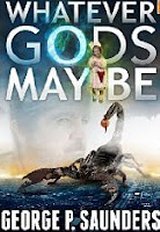
Whatever Gods May Be PDF - George Saunders
George Saunders • Fantasy novels • 411 Pages
(0)
Quate
Review
Save
Share
Book Description
Whatever Gods May Be by George P. Saunders: A Far-Future Time Travel Science Fiction Adventure
Whatever Gods May Be by George P. Saunders is a bold science fiction novel that brings together time travel, cosmic observation, post-apocalyptic survival, alien life, and the fate of humanity on an Earth pushed far beyond recognition. Built around the journey of Rzzdik Zolan, a traveler from a planet a thousand light years away, the book begins with a vast premise: Earth is not merely a setting, but a living experiment observed across eras, wars, collapses, and possible futures. For readers searching for a time travel science fiction book with an epic scale, the novel offers a story that moves from ancient history to the twenty-first century and then into a terrifying vision of Earth one million years in the future.
At the center of the novel is Zolan, an evolutionary observer whose assignment has taken him across many periods of human history. His perspective gives the story a sweeping, almost cosmic range, allowing the narrative to explore humanity from the outside while still placing human survival at its emotional core. When World War III erupts without warning, several characters are thrown into a distant future where civilization has collapsed, the planet has become a burned-out wasteland, and the remaining human species is close to extinction. This combination of space travel, time displacement, alien contact, and apocalyptic fiction gives Whatever Gods May Be a broad appeal for readers who enjoy imaginative speculative fiction with high stakes.
A Story of Time, Evolution, and a Dying Earth
The novel’s power comes from the way it treats time not simply as a device for adventure, but as a force that exposes the fragility of civilizations. Zolan’s travels across human history place Earth within a much larger cosmic framework, where wars, religions, empires, discoveries, and disasters are part of a long evolutionary pattern. The title Whatever Gods May Be suggests uncertainty before the unknown: the unknown powers that shape life, the unknown future waiting beyond catastrophe, and the unknown moral cost of survival when humanity faces its end.
In the far future, Earth has become a nightmarish version of itself. The world is no longer the familiar planet of cities, nations, and progress, but a hostile environment inhabited by mutated predators known as Redeyes and dominated by a mysterious, powerful figure called The Resistor. Human beings have reverted to primitive conditions, and their survival is no longer guaranteed. This setting gives the novel a strong post-apocalyptic science fiction atmosphere, blending the bleakness of a dying planet with the urgency of a rescue mission, a rebellion, and a battle against forces that may be greater than human understanding.
Characters Caught Between Catastrophe and Salvation
Alongside Rzzdik Zolan, the novel introduces Colonel John Phillips and Colonel Cathy Phillips, who are caught in the time-shattering effects of World War III while on a rare shuttle mission to a space station. Their displacement into the ruined future turns a military and scientific mission into a struggle for survival on a transformed Earth. Their daughter, Valry Phillips, becomes a figure of special importance, connected to the possibility of Earth’s salvation or its final destruction. Through Valry, the story gives its cosmic conflict a human center, focusing not only on planets and timelines but on family, inheritance, and the burden placed on the young when older worlds have failed.
The inclusion of Thalick, an intergalactic traveler resembling an enormous scorpion, adds another layer of alien imagination to the novel. Thalick’s presence helps move the story beyond conventional time travel fiction and into broader space opera territory, where different species, worlds, and evolutionary paths intersect. This mix of human and non-human characters gives Whatever Gods May Be a sense of scale that will appeal to readers who enjoy science fiction adventures involving strange allies, powerful enemies, and civilizations separated by time as much as by distance.
Science Fiction with Apocalyptic Stakes
Readers looking for apocalyptic time travel fiction will find that Whatever Gods May Be combines several classic genre elements in one expansive narrative. The novel includes World War III, accidental travel into the future, alien observers, mutated descendants, dying civilizations, and a final struggle over whether humanity can continue. Rather than limiting itself to one timeline or one historical moment, the story stretches across a vast arc, turning Earth’s future into a battlefield where the consequences of human violence and cosmic interference meet.
The far-future world of the novel is especially important for its atmosphere. A million years after the present, Earth is presented as a place where the achievements of humanity have been erased or distorted, leaving behind scattered survivors and predatory beings. This vision gives the book a dark speculative edge, making it suitable for readers who enjoy dystopian science fiction, far-future adventure, and stories about the collapse and possible rebirth of civilization. The novel’s central question is not simply whether the characters can escape danger, but whether Earth itself can be rescued from the fate that time, war, and domination have prepared for it.
Themes of Humanity, Power, and Survival
Beneath its large-scale adventure, Whatever Gods May Be explores themes that are central to speculative fiction: what makes humanity worth saving, whether evolution has a direction, and whether intelligence alone can prevent self-destruction. Zolan’s role as an observer creates a powerful contrast between detachment and involvement. He has watched human history unfold, but the crisis he encounters forces him into a more active role. This movement from witness to participant gives the story moral tension, especially as the future reveals the terrible cost of the choices made in earlier ages.
The figure of The Resistor gives the novel its central darkness. As a mysterious and all-powerful presence, The Resistor represents domination, corruption, and the possibility that Earth’s future may belong not to humanity but to something that has taken control of its ruins. Against this force, Zolan, Thalick, Valry, and the displaced human characters must confront a future that appears almost beyond repair. Their struggle gives the book the shape of a science fiction quest, where survival depends on courage, alliance, and the discovery of hidden possibilities within a devastated world.
For Readers Who Enjoy Expansive Speculative Fiction
Whatever Gods May Be is well suited for readers who enjoy science fiction that moves quickly across big ideas and dramatic scenarios. It will appeal to fans of time travel novels, alien encounter stories, post-apocalyptic adventures, and far-future science fiction where the fate of Earth hangs in the balance. The book’s premise is ambitious, drawing together religious history, global war, evolutionary observation, space travel, and a distant future populated by new forms of life. This makes it a strong choice for readers who prefer imaginative, high-concept storytelling over small-scale realism.
The novel also offers an accessible entry point for readers who enjoy science fiction with clear conflict and adventurous momentum. Its central ingredients are familiar and compelling: a time traveler from another world, a catastrophic war, a family thrown into the future, a child connected to humanity’s destiny, alien allies, monstrous enemies, and a ruined Earth waiting to be reclaimed or lost forever. These elements give the book the feel of a classic speculative adventure while still allowing room for questions about human nature, destiny, and the limits of survival.
A Bold Journey Across Time, Space, and Human Destiny
Whatever Gods May Be by George P. Saunders is a science fiction novel built on scale, danger, and imagination. It asks readers to look at Earth not only as the present world we know, but as a planet with a fragile past and a terrifying possible future. Through Rzzdik Zolan’s journey, the novel turns time travel into a way of measuring humanity’s rise, collapse, and last chance for renewal. Through Valry Phillips and the other displaced characters, it keeps that vast story grounded in personal stakes and the urgent need to resist extinction.
For anyone searching for an adventurous time travel science fiction novel with apocalyptic danger, alien civilizations, mutated future beings, and a dramatic fight for Earth’s survival, Whatever Gods May Be offers a wide-ranging speculative journey. It is a story about the end of worlds and the possibility of saving one, about the mysteries that govern life across time, and about the courage required when the future has become almost impossible to face.
George Saunders
George Saunders is an American author, short story writer, novelist, essayist, and teacher whose work has become central to contemporary literary fiction, especially for readers interested in satire, moral imagination, experimental narrative form, and compassionate social criticism. Although he is now widely recognized as one of the most distinctive writers in modern American literature, Saunders followed an unusual path into fiction. He studied geophysical engineering, worked in technical and industrial settings, and brought into literature a sharp awareness of systems, workplaces, bureaucratic language, consumer culture, and the pressures placed on ordinary people by institutions that often speak in polished slogans while producing real suffering. This background helps explain the strange energy of his fiction: his stories often feel at once futuristic and familiar, comic and devastating, absurd and deeply humane. In works such as CivilWarLand in Bad Decline, Pastoralia, In Persuasion Nation, Tenth of December, and Liberation Day, Saunders explores theme parks, corporate environments, artificial communities, media-saturated worlds, and damaged families, using exaggerated premises to reveal emotional truths about fear, ambition, debt, shame, kindness, and moral choice. His style is instantly recognizable for its blend of vernacular speech, dark humor, surreal invention, and sudden moments of tenderness. Rather than presenting satire as simple ridicule, he uses satire to ask how people become trapped inside economic pressures, cultural scripts, and self-protective stories, and how they might still act with generosity. Saunders achieved a major international breakthrough with Lincoln in the Bardo, his first novel, which won the Booker Prize and expanded his audience far beyond the world of short fiction. The novel uses a chorus of voices to imagine the grief of Abraham Lincoln after the death of his son Willie, while also creating a spiritual landscape filled with comic, tragic, and yearning presences. It is formally daring, emotionally direct, and historically resonant, showing Saunders’s ability to turn an experimental structure into a moving meditation on death, love, national sorrow, and the difficulty of letting go. His later novel Vigil continues many of his central concerns, including mortality, spiritual reckoning, environmental responsibility, corporate power, and the possibility of empathy even at the edge of judgment. Saunders is also admired for A Swim in a Pond in the Rain, a craft book and literary meditation drawn from his long experience teaching Russian short stories, where he examines how narrative attention works and why fiction can sharpen the reader’s moral perception. As a professor of creative writing at Syracuse University, he has influenced many writers not only through his published books but also through his approach to teaching, which emphasizes precision, revision, playfulness, and the ethical force of noticing. His honors include a MacArthur Fellowship, a Guggenheim Fellowship, the PEN/Malamud Award for excellence in the short story, the Story Prize and the Folio Prize for Tenth of December, recognition by Time as one of the world’s most influential people in 2013, and the 2025 Medal for Distinguished Contribution to American Letters. Yet the real significance of George Saunders lies not only in awards or reputation. His fiction has helped renew the short story as a form capable of confronting contemporary life without becoming flatly realistic or narrowly political. He understands that modern cruelty often hides inside ordinary language, that people can be ridiculous and worthy of love at the same time, and that moral awakening may begin in a tiny hesitation before harm. For readers, students, and writers, Saunders offers a model of literary art that is inventive without being cold, funny without being shallow, and compassionate without being sentimental. His books remain especially valuable for anyone seeking fiction that challenges the imagination while deepening the capacity for attention, mercy, and self-examination.
Earn Rewards While Reading!
Every 10 pages you read and spent 30 seconds on every page, earns you 5 reward points! Keep reading to unlock achievements and exclusive benefits.
Read
Rate Now
5 Stars
4 Stars
3 Stars
2 Stars
1 Stars
Whatever Gods May Be Quotes
Top Rated
Latest
Quate
Be the first to leave a quote and earn 10 points
instead of 3
Other books by George Saunders
Other books like Whatever Gods May Be
'%20/%3e%3c/svg%3e "Fantastic Beasts: The Crimes of Grindelwald - the Original Screenplay")
J. K. Rowling.
Fantasy novels
(0)
7658
English
Comments
Be the first to leave a comment and earn 5 points
instead of 3