

The source of the book
This book is published for the public benefit under a Creative Commons license, or with the permission of the author or publisher. If you have any objections to its publication, please contact us.
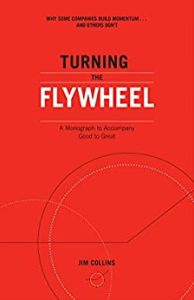
Turning the Flywheel PDF - Jim Collins
Jim Collins • Financial management • 67 Pages
(0)
Quate
Review
Save
Share
Book Description
Turning the Flywheel: A Monograph to Accompany Good to Great by Jim Collins is a concise business book published in 2019 by Harper Business, with the U.S. paperback edition released on February 26, 2019. The book is short, focused, and practical, running about 46 pages in its Harper Business edition. It is not a novel but a management monograph designed to expand one of Collins’s most memorable ideas from Good to Great: the flywheel effect.
In Turning the Flywheel, Jim Collins explains how lasting success rarely comes from one dramatic breakthrough, one lucky decision, or one sudden innovation. Instead, great organizations build momentum through a sequence of disciplined actions that reinforce one another over time. Collins uses the image of a heavy flywheel: at first, pushing it requires great effort, but as each turn adds force to the next, the wheel begins to move faster. Eventually, accumulated effort produces momentum that can look sudden from the outside, even though it is the result of consistent work.
The book begins by connecting the flywheel concept to real organizational examples, most notably Amazon. Collins’s own website describes the monograph as beginning with the story of Amazon applying the flywheel idea after the dot-com crash, clarifying the drivers of its business momentum and using them to build what Collins calls relentless momentum. This example helps readers see that a flywheel is not a vague motivational metaphor. It is a specific strategic model: one action leads to another, each element strengthens the next, and the cycle repeats.
Collins encourages leaders to identify their own organization’s flywheel rather than copy another company’s model. A retailer, a school, a hospital, a nonprofit, or a technology company may all have different flywheels. The important task is to understand the chain of cause and effect that creates durable results. For example, an organization might improve customer experience, which increases loyalty, which drives growth, which funds better systems, which further improves customer experience. The exact sequence matters because it reveals where leaders should focus their energy.
A central message of Turning the Flywheel is that momentum depends on discipline. Collins warns against jumping from one initiative to another without understanding what truly drives progress. The flywheel works only when leaders keep pushing in a coherent direction. This makes the book especially useful for entrepreneurs, executives, managers, nonprofit leaders, and anyone trying to turn scattered activity into sustained performance.
The monograph also explains that the flywheel is not permanent unless it is protected and refreshed. Markets shift, organizations grow, and old assumptions can become weak. Collins does not present the flywheel as a magic formula; instead, he treats it as a thinking tool. Leaders must test their model against evidence, examine successes and failures, and refine the sequence until it reflects what actually works.
Because the book is brief, it reads more like a strategic guide than a full-length business classic. Its value lies in its clarity. Collins takes one concept from Good to Great and shows how to apply it in practical terms. Readers who already know Collins’s work will find it a useful companion, while new readers may see it as an accessible introduction to his broader ideas about disciplined leadership and organizational excellence.
Overall, Turning the Flywheel by Jim Collins is a compact but influential business book about how organizations build momentum through consistent, connected actions. Published by Harper Business in 2019, it offers a clear framework for understanding why success compounds over time and why leaders should focus less on dramatic breakthroughs and more on the repeated actions that make breakthroughs possible.
Jim Collins
Jim Collins is an influential American author, researcher, teacher, and leadership thinker whose work has shaped the modern conversation about business excellence, organizational endurance, disciplined management, and the long-term conditions that allow companies and institutions to become truly great. Best known for Good to Great, Built to Last, Great by Choice, How the Mighty Fall, Beyond Entrepreneurship, Good to Great and the Social Sectors, Turning the Flywheel, and BE 2.0, Collins has built a reputation for combining rigorous research with memorable, practical ideas that leaders can apply across corporate, entrepreneurial, nonprofit, educational, healthcare, government, and faith-based environments. His writing is especially valued because it does not treat success as a matter of charisma, luck, fashion, or short-term tactics; instead, it asks deeper questions about discipline, people, culture, values, strategic clarity, and the repeated decisions that create durable performance over time. In Good to Great, Collins explores whether a good company can become a great company and identifies principles such as Level 5 Leadership, First Who Then What, the Hedgehog Concept, and the Flywheel, concepts that have become part of the everyday vocabulary of managers, founders, consultants, board members, and students of leadership. In Built to Last, coauthored with Jerry Porras, he studies visionary companies and examines why some organizations remain exceptional across generations of leaders, market changes, and technological disruptions. His work also addresses decline and resilience: How the Mighty Fall explains how once-powerful institutions can lose their way, while Great by Choice, written with Morten Hansen, studies why some enterprises perform exceptionally well in uncertain, chaotic, and fast-moving conditions. Beyond Entrepreneurship and BE 2.0 return to the practical needs of entrepreneurs and leaders of small and mid-sized companies, offering guidance on vision, strategy, leadership effectiveness, and tactical execution. Collins began his research and teaching career at the Stanford Graduate School of Business, where he received a Distinguished Teaching Award in 1992, and in 1995 he founded a management laboratory in Boulder, Colorado, where he continues to conduct research and work with chief executives and senior leadership teams. He holds a bachelor’s degree in mathematical sciences and a Master of Business Administration from Stanford University, along with honorary doctoral degrees from the University of Colorado and the Peter F. Drucker Graduate School of Management at Claremont Graduate University. Forbes selected him in 2017 as one of the 100 Greatest Living Business Minds, a recognition that reflects the reach of his ideas beyond conventional management publishing. Collins is also known for expanding his inquiry beyond business into the broader question of exceptional human endeavor. His newer book, What to Make of a Life, extends his research lens toward the challenge of constructing and reconstructing a meaningful life through transitions, uncertainty, and defining moments. For readers looking for authoritative books on leadership, company culture, organizational strategy, entrepreneurial growth, and sustainable success, Jim Collins remains a central figure because his books are research-based, readable, conceptually clear, and enduringly useful for anyone who wants to build something that lasts.
Earn Rewards While Reading!
Every 10 pages you read and spent 30 seconds on every page, earns you 5 reward points! Keep reading to unlock achievements and exclusive benefits.
Read
Rate Now
5 Stars
4 Stars
3 Stars
2 Stars
1 Stars
Turning the Flywheel Quotes
Top Rated
Latest
Quate
Be the first to leave a quote and earn 10 points
instead of 3
Other books by Jim Collins
'%20/%3e%3c/svg%3e "Built To Last: Successful Habits of Visionary Companies by Jim Collins")
Jim Collins.
Financial management
(0)
2
English
Other books like Turning the Flywheel
13969
English
Comments
Be the first to leave a comment and earn 5 points
instead of 3