

The source of the book
This book is published for the public benefit under a Creative Commons license, or with the permission of the author or publisher. If you have any objections to its publication, please contact us.
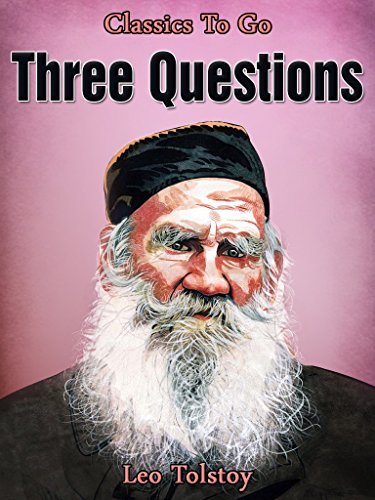
Three Questions PDF - Leo Tolstoy
Leo Tolstoy • literature • 15 Pages
(0)
Quate
Review
Save
Share
Book Description
Three Questions by Leo Tolstoy: A Timeless Parable About Wisdom, Action, and the Meaning of the Present
Three Questions by Leo Tolstoy is a brief yet deeply memorable literary parable that explores one of the most enduring human concerns: how to live wisely. Centered on a king who wants to discover the secret of never failing in life, the story transforms a simple quest into a profound meditation on time, duty, compassion, and moral awareness. Although short in length, Three Questions carries the philosophical depth and spiritual clarity often associated with Tolstoy’s later moral tales, making it a powerful choice for readers interested in classic literature, inspirational short stories, ethical storytelling, and meaningful life lessons. Tolstoy’s reputation as one of the great masters of realistic fiction rests largely on works such as War and Peace and Anna Karenina, but his shorter moral writings also reveal his lifelong concern with conscience, human responsibility, and the search for meaning. (Encyclopedia Britannica)
A Simple Story Built Around Life’s Most Important Questions
The story begins with a ruler who believes that if he can answer three essential questions, he will be able to make the right decisions in every situation. He wants to know the right time to act, the right people to listen to, and the most important thing to do. These questions give the tale its structure and its lasting appeal, because they are not limited to kings, courts, or distant historical settings. They are questions every thoughtful reader can recognize from ordinary life: When should I act? Whose voice matters most? What deserves my attention before everything else?
In true parable form, Tolstoy does not build the story through dramatic spectacle or complicated plot twists. Instead, he uses clarity, restraint, and moral focus. The king seeks answers from learned men, but their responses differ, showing the limits of abstract advice when it is separated from lived experience. His search eventually leads him away from power and ceremony toward a humbler encounter with a wise hermit. Through this movement, Three Questions shifts from theory to action, from ambition to humility, and from the desire to control life to the deeper need to respond rightly to the present moment.
Tolstoy’s Moral Vision in a Short and Accessible Classic
One of the strengths of Three Questions is the way Tolstoy turns philosophical ideas into a story that is easy to read but difficult to forget. The language is direct, the characters are symbolic without feeling empty, and the lesson grows naturally from what happens rather than from a lecture imposed on the reader. This makes the story especially valuable for students, teachers, general readers, and anyone looking for a short classic story with a moral message. It is often read as a lesson in mindfulness, compassion, ethical action, and the importance of being fully present with the people and responsibilities immediately before us.
The tale belongs to the tradition of moral and spiritual storytelling that became especially important in Tolstoy’s later life. After the great psychological and social range of his major novels, Tolstoy increasingly wrote works that addressed practical questions of faith, justice, simplicity, and human goodness. Three Questions reflects this late-Tolstoyan concern with the value of ordinary action. Rather than praising status, intelligence, or worldly success, the story suggests that wisdom is found in attention, service, and the moral demands of the moment. Britannica notes that Tolstoy’s later fiction includes moral tales written for common people, a context that helps explain the directness and universal appeal of a story like this. (Encyclopedia Britannica)
Themes of Time, Responsibility, and Compassion
At the heart of Three Questions by Leo Tolstoy is the theme of time. The king wants to know the correct time for every action because he imagines that success depends on perfect planning. Tolstoy gently challenges this desire for certainty. The story does not dismiss thoughtfulness or preparation, but it shows that life cannot be mastered through calculation alone. The most important moment is not always the one written into a schedule or predicted by experts; it is often the moment that asks for attention now.
Another central theme is the importance of human presence. The king begins by searching for knowledge that will make him powerful and effective, yet his journey teaches him to notice the person directly in front of him. In this sense, the story is not only about wisdom but also about relationship. Tolstoy presents moral life as something immediate and practical. The people who matter most are not always the famous, the influential, or the strategically useful. They are the people whose needs enter our lives and call for our response.
Compassion is also essential to the story’s meaning. Without turning the tale into sentimental moralizing, Tolstoy shows that true understanding comes through action, especially through helping another person. The king’s transformation is not achieved by receiving a clever answer but by participating in an act of care. This gives Three Questions its emotional force. The lesson is not merely something to be understood; it is something to be lived.
Why Readers Still Search for Three Questions by Leo Tolstoy
Readers continue to look for Three Questions by Leo Tolstoy summary, analysis, themes, and moral lesson because the story offers a rare combination of simplicity and depth. It can be read quickly, but its message expands with reflection. For younger readers, it introduces the structure of a parable and the idea that stories can teach ethical values. For adult readers, it offers a concise reminder of priorities that are easy to lose in a life filled with planning, distraction, regret, and anxiety about the future.
The story is also useful for classrooms and literature discussions because it invites interpretation without becoming obscure. Students can examine the king’s character, the role of the hermit, the contrast between intellectual answers and practical wisdom, and the way Tolstoy uses setting and action to reveal meaning. At the same time, general readers can enjoy it as a beautiful and calming story about presence, forgiveness, and the quiet power of doing what is needed when it is needed.
A Short Classic With Lasting Spiritual and Literary Value
Three Questions remains one of Tolstoy’s most approachable short works because it speaks across age, culture, and background. It does not require prior knowledge of Russian literature, history, or philosophy. Yet it opens a doorway into Tolstoy’s larger moral universe, where the worth of a life is measured not by achievement alone but by truthfulness, kindness, humility, and attention to others. The story’s enduring relevance comes from its refusal to offer wisdom as an abstract formula. Instead, it shows wisdom emerging from the ordinary human encounter: a question asked, a task performed, a stranger helped, a moment recognized.
For readers seeking a meaningful classic that can be read in a single sitting but remembered for years, Three Questions by Leo Tolstoy is an excellent choice. It is a story about decision-making, but also about surrendering the illusion of perfect control. It is a story about leadership, but also about humility. Most importantly, it is a story about discovering that the deepest answers to life’s questions are often found not far away, not in theory, and not in the future, but in the present moment and in the person who stands before us.
Leo Tolstoy
Leo Tolstoy is one of the most influential writers in world literature, a Russian novelist, moral thinker, and social critic whose work helped define the possibilities of the modern novel. Born into an aristocratic family in Russia, he grew up close to the rural estate life that later became central to his imagination, his ethical concerns, and his understanding of class, labor, family, faith, and personal responsibility. Tolstoy is best known for the monumental novels War and Peace and Anna Karenina, two works that continue to stand among the highest achievements of literary realism. His fiction is celebrated not merely for its scale, but for its extraordinary ability to portray human consciousness, social pressure, moral confusion, and the hidden movement of history through the lives of individuals. In War and Peace, Tolstoy transforms the historical novel into a vast meditation on war, fate, leadership, memory, and ordinary human experience. He portrays the Napoleonic era not as a simple sequence of heroic decisions, but as a complex web of personal choices, accidents, social customs, emotions, and forces beyond the control of any single ruler or general. In Anna Karenina, he offers one of literature’s most penetrating studies of love, marriage, desire, jealousy, social judgment, and spiritual hunger, creating characters whose inner lives feel immediate, contradictory, and painfully human. Tolstoy’s narrative style combines simplicity with depth: he can describe a ballroom, a battlefield, a family quarrel, a harvest, or a moment of private doubt with such precision that each scene becomes a window into moral and psychological truth. His characters are memorable because they are never reduced to symbols; they change, hesitate, deceive themselves, seek forgiveness, suffer, and grow. Beyond his novels, Tolstoy wrote short fiction, essays, autobiographical works, religious reflections, and educational writings that reveal a lifelong struggle to reconcile art, conscience, and everyday life. In his later years, he became increasingly concerned with questions of nonviolence, poverty, property, organized religion, and the ethical meaning of Christianity. His critique of violence and his insistence on moral self-examination influenced readers far beyond Russia and helped shape later discussions of peaceful resistance, social reform, and spiritual simplicity. As an author for book lovers, Tolstoy remains essential because his works speak to both private feeling and public history. He examines the intimate life of families while also asking how nations move toward war, how societies punish those who break their rules, and how individuals can live truthfully in a world built on pride, ambition, and illusion. His influence can be felt in modern realism, psychological fiction, historical narrative, philosophical literature, and moral essays. Readers return to Tolstoy because his books do not offer easy answers; they invite deep attention to life itself. He writes about birth, death, love, work, faith, conflict, and forgiveness with a seriousness that makes ordinary experience feel immense. Leo Tolstoy’s legacy endures because he created literature that is both artistically powerful and ethically demanding, literature that asks every generation to reconsider what it means to live honestly, love responsibly, and search for meaning in a complicated world.
Earn Rewards While Reading!
Every 10 pages you read and spent 30 seconds on every page, earns you 5 reward points! Keep reading to unlock achievements and exclusive benefits.
Read
Rate Now
5 Stars
4 Stars
3 Stars
2 Stars
1 Stars
Three Questions Quotes
Top Rated
Latest
Quate
Be the first to leave a quote and earn 10 points
instead of 3
Other books by Leo Tolstoy
Other books like Three Questions
'%20/%3e%3c/svg%3e "The Missionary Position: Mother Teresa in Theory and Practice")
3649
English
Comments
Be the first to leave a comment and earn 5 points
instead of 3