

The source of the book
This book is published for the public benefit under a Creative Commons license, or with the permission of the author or publisher. If you have any objections to its publication, please contact us.
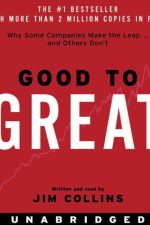
Good to Great PDF - Jim Collins
Jim Collins • Financial management • 368 Pages
(0)
Quate
Review
Save
Share
Book Description
Good to Great: Why Some Companies Make the Leap... and Others Don’t is a nonfiction business and management book by Jim Collins, first published in 2001 by HarperBusiness, an imprint associated with HarperCollins. The book went on sale on October 16, 2001, and focuses on one central question: why do some organizations move from solid, ordinary performance to sustained excellence while others remain merely good?
In Good to Great, Jim Collins presents the results of a research project that began with 1,435 companies and narrowed the field to 11 companies that, according to the study’s criteria, made a significant and sustained leap in performance. Rather than offering a motivational story or a simple success formula, Collins organizes the book around patterns his research team believed were shared by these “good-to-great” companies. The result is a structured business book that combines case studies, leadership analysis, and management principles.
Because Good to Great is not a novel, it does not have a fictional plot. Its “story” is the progression of an investigation. Collins begins by challenging the assumption that dramatic corporate transformation usually comes from celebrity CEOs, radical change programs, or lucky market timing. Instead, he argues that lasting greatness is built through disciplined leadership, disciplined thinking, and disciplined action.
One of the book’s most important ideas is Level 5 Leadership. Collins describes these leaders as people who combine personal humility with intense professional will. They are ambitious, but their ambition is directed toward the organization rather than their own public image. This idea becomes the foundation for the rest of the book, because Collins argues that good-to-great companies were often led by quiet, determined leaders rather than flashy personalities.
Another major concept is “First Who, Then What.” Collins suggests that great companies focus first on getting the right people into the organization and the wrong people out before deciding on the final strategic direction. In the book’s language, leaders must get the right people “on the bus” before choosing exactly where to drive it. This principle emphasizes hiring, discipline, and cultural fit over short-term planning.
The book also explains the Hedgehog Concept, one of its most memorable frameworks. Collins presents it as the intersection of three questions: what the organization can be best in the world at, what it is deeply passionate about, and what drives its economic or resource engine. The idea is that great companies do not chase every opportunity; they develop clarity about their core strength and then focus relentlessly on it.
Collins also discusses the need to confront difficult facts without losing faith in eventual success. This part of the book encourages leaders to create environments where truth can be heard, even when it is uncomfortable. In the broader summary of Good to Great, this principle supports a realistic approach to management: optimism alone is not enough, and denial can damage an organization’s ability to improve.
The later sections of the book explore the culture of discipline, technology as an accelerator, and the Flywheel Effect. Collins argues that technology does not create greatness by itself; rather, the right technology can accelerate progress when it fits the company’s core concept. The Flywheel Effect describes transformation as a gradual buildup of momentum, not a single breakthrough moment. Sustained success comes from repeated, consistent pushes in the same direction until results compound.
Overall, Good to Great by Jim Collins is a research-based business book about leadership, strategy, organizational discipline, and long-term performance. Its content is especially relevant for executives, entrepreneurs, managers, and readers interested in corporate growth. While some later critics have questioned parts of the book’s methodology and the long-term performance of some featured companies, Good to Great remains widely read because it gives readers a clear vocabulary for thinking about how organizations improve. Its lasting value lies in its practical central message: greatness is not presented as an accident, but as the result of disciplined people making disciplined decisions over time.
Jim Collins
Jim Collins is an influential American author, researcher, teacher, and leadership thinker whose work has shaped the modern conversation about business excellence, organizational endurance, disciplined management, and the long-term conditions that allow companies and institutions to become truly great. Best known for Good to Great, Built to Last, Great by Choice, How the Mighty Fall, Beyond Entrepreneurship, Good to Great and the Social Sectors, Turning the Flywheel, and BE 2.0, Collins has built a reputation for combining rigorous research with memorable, practical ideas that leaders can apply across corporate, entrepreneurial, nonprofit, educational, healthcare, government, and faith-based environments. His writing is especially valued because it does not treat success as a matter of charisma, luck, fashion, or short-term tactics; instead, it asks deeper questions about discipline, people, culture, values, strategic clarity, and the repeated decisions that create durable performance over time. In Good to Great, Collins explores whether a good company can become a great company and identifies principles such as Level 5 Leadership, First Who Then What, the Hedgehog Concept, and the Flywheel, concepts that have become part of the everyday vocabulary of managers, founders, consultants, board members, and students of leadership. In Built to Last, coauthored with Jerry Porras, he studies visionary companies and examines why some organizations remain exceptional across generations of leaders, market changes, and technological disruptions. His work also addresses decline and resilience: How the Mighty Fall explains how once-powerful institutions can lose their way, while Great by Choice, written with Morten Hansen, studies why some enterprises perform exceptionally well in uncertain, chaotic, and fast-moving conditions. Beyond Entrepreneurship and BE 2.0 return to the practical needs of entrepreneurs and leaders of small and mid-sized companies, offering guidance on vision, strategy, leadership effectiveness, and tactical execution. Collins began his research and teaching career at the Stanford Graduate School of Business, where he received a Distinguished Teaching Award in 1992, and in 1995 he founded a management laboratory in Boulder, Colorado, where he continues to conduct research and work with chief executives and senior leadership teams. He holds a bachelor’s degree in mathematical sciences and a Master of Business Administration from Stanford University, along with honorary doctoral degrees from the University of Colorado and the Peter F. Drucker Graduate School of Management at Claremont Graduate University. Forbes selected him in 2017 as one of the 100 Greatest Living Business Minds, a recognition that reflects the reach of his ideas beyond conventional management publishing. Collins is also known for expanding his inquiry beyond business into the broader question of exceptional human endeavor. His newer book, What to Make of a Life, extends his research lens toward the challenge of constructing and reconstructing a meaningful life through transitions, uncertainty, and defining moments. For readers looking for authoritative books on leadership, company culture, organizational strategy, entrepreneurial growth, and sustainable success, Jim Collins remains a central figure because his books are research-based, readable, conceptually clear, and enduringly useful for anyone who wants to build something that lasts.
Earn Rewards While Reading!
Every 10 pages you read and spent 30 seconds on every page, earns you 5 reward points! Keep reading to unlock achievements and exclusive benefits.
Read
Rate Now
5 Stars
4 Stars
3 Stars
2 Stars
1 Stars
Good to Great Quotes
Top Rated
Latest
Quate
Be the first to leave a quote and earn 10 points
instead of 3
Other books by Jim Collins
'%20/%3e%3c/svg%3e "Built To Last: Successful Habits of Visionary Companies by Jim Collins")
Jim Collins.
Financial management
(0)
2
English
Other books like Good to Great
13969
English
Comments
Be the first to leave a comment and earn 5 points
instead of 3