

The source of the book
This book is published for the public benefit under a Creative Commons license, or with the permission of the author or publisher. If you have any objections to its publication, please contact us.
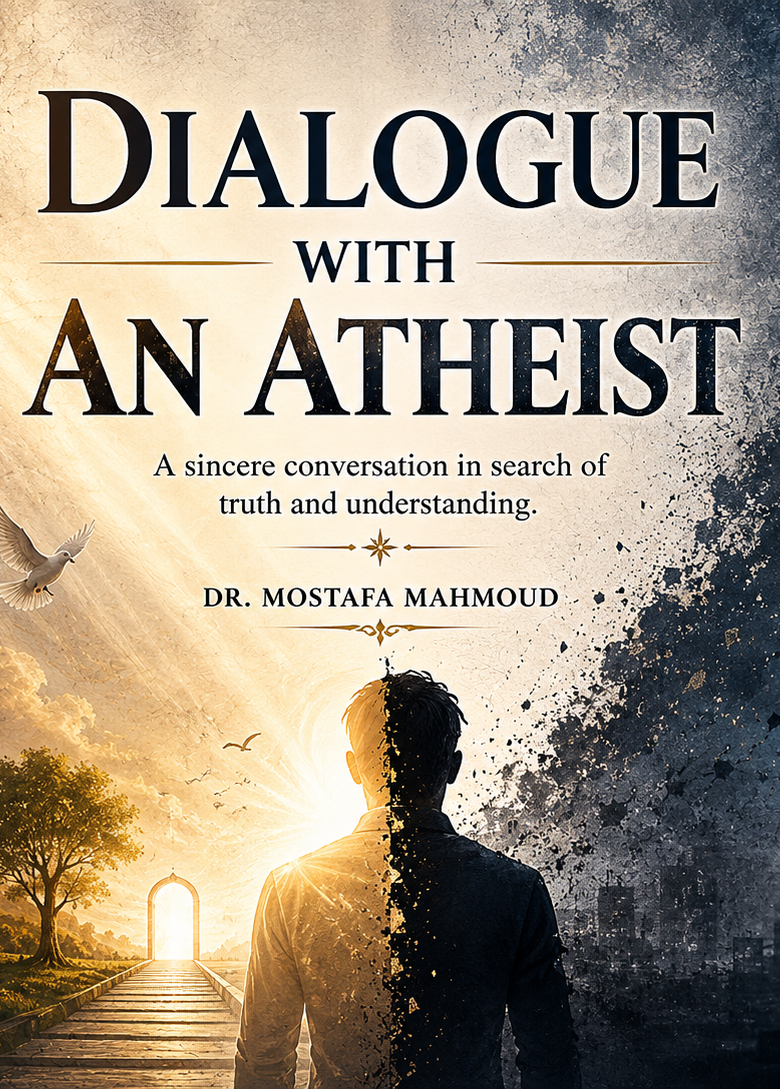
Description of Dialogue with My Atheist Friend PDF - Mustafa Mahmoud
Mustafa Mahmoud • Philosophy • 94 Pages
(0)
Quate
Review
Save
Share
Book Description
Description of Dialogue with My Atheist Friend by Mustafa Mahmoud
Dialogue with My Atheist Friend by Mustafa Mahmoud is one of the most widely discussed Arabic works on faith, doubt, atheism, and rational inquiry. Originally known in Arabic as the book is built around a direct intellectual conversation between the author and an atheist friend who raises difficult questions about God, religion, creation, destiny, freedom, evil, the afterlife, and the relationship between science and belief. The book is commonly listed among Mustafa Mahmoud’s works on responding to atheistic arguments and exploring Islamic faith through reasoned dialogue.
What makes this book especially memorable is its conversational style. Instead of presenting faith as a closed lecture or a set of abstract doctrines, Mustafa Mahmoud allows the questions to appear openly and sharply. The atheist friend asks what many readers may hesitate to ask: Who created God? Why does evil exist? Is man truly free, or is everything predetermined? How can heaven, hell, resurrection, and divine justice be understood? Through these questions, the book becomes more than a defense of religion; it becomes a thoughtful journey into the human need for meaning, certainty, and intellectual honesty.
A Powerful Book on Faith, Doubt, and Reason
The central strength of Dialogue with My Atheist Friend lies in its ability to treat doubt as a serious human experience. Mustafa Mahmoud does not write as though questioning is always a weakness. Instead, he approaches doubt as a stage that may lead either to confusion or to deeper understanding, depending on how honestly the mind searches for truth. This gives the book a distinctive emotional and intellectual power, especially for readers who are interested in books about belief and atheism, Islam and reason, or philosophical discussions about God.
The book speaks to readers who want answers that are not purely emotional and not overly academic. Mustafa Mahmoud uses examples from daily life, reflections on the order of the universe, observations about human nature, and arguments about consciousness, morality, and responsibility. His method is simple enough for general readers, yet serious enough to invite deeper reflection. This balance is one of the reasons the book continues to attract readers across generations.
The Dialogue Format and Its Appeal
The dialogue structure gives the book a lively rhythm. Each question opens a new door, and each answer leads the reader into a wider discussion about existence, morality, and the limits of human knowledge. Rather than moving through dry theoretical chapters, the book feels like an active debate between two minds. This makes Dialogue with My Atheist Friend especially accessible for readers who may be new to religious philosophy or Islamic thought.
The “atheist friend” in the book functions as more than a single character. He represents a collection of modern objections to religion: skepticism toward unseen realities, suspicion of inherited belief, trust in material explanations, and discomfort with questions of divine justice. Mustafa Mahmoud responds to these objections with a style that combines logic, analogy, spiritual reflection, and literary force. The result is a book that feels direct, personal, and urgent.
Science, Religion, and the Search for Meaning
One of the most important themes in Dialogue with My Atheist Friend is the relationship between science and religion. Mustafa Mahmoud, who was trained as a physician before becoming one of the Arab world’s best-known writers and thinkers, often approached faith through the language of observation, order, and wonder. In this book, he does not present science as an enemy of belief. Instead, he argues that scientific discovery can deepen the sense of mystery and point toward questions that material explanation alone may not fully answer.
The book challenges the idea that the universe can be reduced to matter without meaning. It asks whether consciousness, moral responsibility, beauty, longing, and the search for justice can be fully explained by physical processes alone. For readers interested in Islamic philosophy, arguments for the existence of God, or the limits of materialism, this aspect of the book offers a clear and engaging introduction.
Questions About God, Evil, Freedom, and Destiny
Among the most compelling parts of the book are its discussions of evil, free will, and divine justice. These are not simple topics, and Mustafa Mahmoud does not treat them as minor objections. He recognizes that questions about suffering, inequality, death, and human responsibility are among the deepest questions a person can ask. Through the dialogue, he attempts to show that belief in God does not remove complexity from life, but gives that complexity a larger moral and spiritual framework.
The book also examines the question of destiny. Is man responsible for his actions if God knows everything? How can freedom exist alongside divine knowledge? What does accountability mean in a universe governed by God? These questions make the book valuable not only for readers debating atheism, but also for believers who want to think more deeply about concepts they may have inherited without examination.
Mustafa Mahmoud’s Distinctive Style
Mustafa Mahmoud’s writing style is one of the main reasons Dialogue with My Atheist Friend remains popular. His language is direct, clear, and often intense. He avoids unnecessary complexity, yet he does not weaken the seriousness of the subject. He writes with the energy of someone who has personally wrestled with the questions he discusses, which gives the book an intimate and persuasive tone.
Readers familiar with Mustafa Mahmoud’s other works, such as My Journey from Doubt to Faith, will recognize his recurring concern with the movement from uncertainty to conviction. He is not interested in blind imitation or shallow certainty. Instead, he repeatedly returns to the idea that faith should be conscious, reflective, and alive. In this sense, Dialogue with My Atheist Friend is not only a response to atheism; it is also an invitation to believers to understand what they believe and why.
Who Should Read Dialogue with My Atheist Friend?
Dialogue with My Atheist Friend is suitable for readers interested in religious thought, Islamic belief, philosophy of religion, and books that discuss atheism from an Islamic perspective. It is especially useful for readers who prefer a clear conversational approach rather than a specialized academic study. The book can appeal to young readers beginning to ask existential questions, to believers seeking stronger intellectual grounding, and to anyone interested in how modern Arabic thought has addressed the tension between faith and skepticism.
It is also a meaningful choice for readers who appreciate books that do not avoid difficult questions. The value of the book comes from its willingness to place challenging objections at the center of the discussion. Whether the reader agrees with every argument or not, the book offers a powerful example of how faith can be presented through dialogue rather than silence, fear, or dismissal.
Why This Book Still Matters
The continued relevance of Dialogue with My Atheist Friend comes from the timeless nature of its questions. Human beings continue to ask where the universe came from, why they exist, what happens after death, whether justice has a final meaning, and whether the mind can find peace without faith. These questions have not disappeared; in many ways, they have become even more visible in modern discussions about science, secularism, religion, and identity.
For this reason, the book remains an important title for readers searching for a thoughtful book about faith and atheism, a readable introduction to Islamic responses to doubt, or a philosophical dialogue about God and human existence. It combines intellectual debate with spiritual concern, making it both accessible and thought-provoking.
A Thought-Provoking Work on Belief and the Human Search for Truth
In the end, Dialogue with My Atheist Friend by Mustafa Mahmoud is a book about more than argument. It is about the human struggle to understand existence, the courage to ask difficult questions, and the possibility that sincere doubt can become the beginning of a deeper journey toward faith. Through its sharp questions, clear answers, and reflective style, the book offers a memorable reading experience for anyone interested in the meeting point between reason, religion, science, and the search for meaning.
It remains one of Mustafa Mahmoud’s most influential works because it does not treat belief as a passive inheritance, but as a living question that must be examined, understood, and renewed. For readers seeking a clear, engaging, and intellectually serious exploration of faith versus atheism, this book continues to offer a powerful entry point into one of the most important conversations in modern religious thought.
Mustafa Mahmoud
Mustafa Mahmoud is one of the most influential Egyptian and Arab intellectual figures of the twentieth century, remembered as a physician, author, philosopher, television presenter, and public thinker whose work brought together science, faith, literature, and existential inquiry. Born Mustafa Kamal Mahmoud Hussein in 1921, he studied medicine and worked as a doctor, specializing in chest diseases, before becoming widely known for his prolific writing and for his ability to translate complex scientific, philosophical, and spiritual questions into clear, accessible language. Mustafa Mahmoud’s reputation rests not only on the number of books he wrote, but also on the unusual range of his interests: he wrote about religion, doubt, belief, physics, the human body, psychology, social change, ethics, political life, and the inner struggles of modern humanity. His most famous work, “My Journey from Doubt to Faith,” became a landmark in Arabic intellectual literature because it framed belief not as an inherited slogan, but as the result of questioning, reflection, intellectual honesty, and a long personal search for meaning. In that book and in others such as “Dialogue with My Atheist Friend,” “God and Man,” “The Qur’an: An Attempt at a Modern Understanding,” “I Saw God,” and “Einstein and Relativity,” he explored the tension between materialist explanations of life and the spiritual hunger that he believed remained at the core of the human condition. His writing style is direct, reflective, and often dramatic; he uses examples from science, everyday life, and personal observation to make abstract ideas feel immediate and emotionally relevant. For readers interested in Arabic nonfiction, Islamic thought, popular science, and modern spiritual literature, Mustafa Mahmoud remains a central figure because he helped create a bridge between the educated public and subjects that might otherwise have seemed remote or difficult. His television program “Science and Faith” gave him an even broader audience, turning him into a familiar voice in Arab households for decades. Through the program, he presented scientific wonders related to the universe, nature, biology, animals, medicine, and technology, then connected those wonders to reflections on divine wisdom, order, and human responsibility. The program’s success came from its distinctive combination of documentary curiosity, spiritual contemplation, and calm explanation, and it helped shape the way generations of viewers thought about science as a path to wonder rather than as a purely mechanical body of facts. Mustafa Mahmoud also wrote fiction, plays, essays, and social criticism, showing that his literary identity was not limited to religious or scientific topics. His stories and dramatic writings often reveal a concern with moral conflict, alienation, freedom, class tension, and the search for authenticity in a rapidly changing society. He was not a conventional preacher, nor was he a narrowly academic philosopher; his appeal came from his restless questioning and from his willingness to speak to ordinary readers without reducing the seriousness of the issues he addressed. His legacy also includes charitable and social work associated with the mosque and foundation bearing his name in Cairo, which strengthened his public image as a figure who linked thought with service. Although some of his views generated debate, his importance in Arab cultural history remains substantial. Mustafa Mahmoud continues to be read because his books speak to readers who are trying to reconcile reason with faith, science with spirituality, and personal doubt with the desire for certainty. As an author biography, his name stands for a distinctive blend of medical knowledge, literary craft, philosophical curiosity, and a deep commitment to making knowledge meaningful for the widest possible audience.
Earn Rewards While Reading!
Every 10 pages you read and spent 30 seconds on every page, earns you 5 reward points! Keep reading to unlock achievements and exclusive benefits.
Read
Rate Now
5 Stars
4 Stars
3 Stars
2 Stars
1 Stars
Description of Dialogue with My Atheist Friend Quotes
Top Rated
Latest
Quate
Be the first to leave a quote and earn 10 points
instead of 3
Other books like Description of Dialogue with My Atheist Friend
'%20/%3e%3c/svg%3e "The Dunayevskaya-Marcuse-Fromm correspondence : dialogues on Hegel, Marx, and critical theory")
Eric Fromm.
Philosophy
(0)
2288
English
Comments
Be the first to leave a comment and earn 5 points
instead of 3