

The source of the book
This book is published for the public benefit under a Creative Commons license, or with the permission of the author or publisher. If you have any objections to its publication, please contact us.
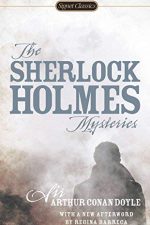
The Sherlock Holmes Mysteries PDF - Arthur Conan Doyle
Arthur Conan Doyle • Crime novels and mysteries • 521 Pages
(0)
Quate
Review
Save
Share
Book Description
The Sherlock Holmes Mysteries by Arthur Conan Doyle is a selected collection of Sherlock Holmes detective stories, published in this edition by Signet / Penguin Publishing Group in 2014. The volume runs to 544 pages and includes an introduction by Anne Perry and an afterword by Regina Barreca. Because Sherlock Holmes stories have been reprinted in many editions, the publication details can vary, but this specific edition is listed by Penguin as The Sherlock Holmes Mysteries, author Sir Arthur Conan Doyle, publisher Penguin Publishing Group, publication date April 1, 2014. (Google Books)
Arthur Conan Doyle’s Sherlock Holmes first became one of literature’s most enduring detectives through stories published in the late nineteenth and early twentieth centuries. The wider Sherlock Holmes canon includes four novels and fifty-six short stories, originally collected across books such as The Adventures of Sherlock Holmes in 1892, The Memoirs of Sherlock Holmes in 1894, The Return of Sherlock Holmes in 1905, His Last Bow in 1917, and The Case-Book of Sherlock Holmes in 1927. The Sherlock Holmes Mysteries presents a compact selection of twenty-two stories, making it a useful introduction to Holmes, Dr. John Watson, and Conan Doyle’s classic method of detective fiction.
The book’s content centers on Sherlock Holmes, the brilliant consulting detective of 221B Baker Street, and his loyal friend and narrator, Dr. Watson. Most stories begin with a puzzling visitor, a strange newspaper notice, an unexplained crime, or a troubling personal secret. Holmes studies the clues with sharp observation, logical reasoning, and an ability to notice what others overlook. Watson, more emotional and practical, records the cases and often stands in for the reader, reacting with surprise as Holmes reconstructs hidden motives from small details.
The plot structure of the collection is episodic rather than one continuous novel. Each mystery introduces a separate case, but the stories are linked by the partnership between Holmes and Watson, the atmosphere of Victorian and Edwardian London, and the recurring contrast between outward appearances and concealed truth. Conan Doyle’s mysteries often begin with ordinary settings—a home, a country estate, a workplace, a railway journey—and gradually reveal blackmail, theft, deception, revenge, or murder beneath the surface.
Among the best-known Sherlock Holmes stories are cases involving scandal, mistaken identity, secret societies, strange family histories, and carefully staged crimes. Holmes is not simply a police detective; he is an independent specialist who is called in when official methods fail. Scotland Yard officers such as Inspector Lestrade may appear, but Holmes usually solves the case by combining forensic detail, human psychology, and imaginative reasoning. His deductions can seem almost magical at first, yet Conan Doyle usually explains them through observable evidence: mud on a shoe, cigar ash, handwriting, a dog’s silence, a stain, or a contradiction in a witness’s story.
Dr. Watson gives the stories their warmth and accessibility. He admires Holmes but does not always understand him, which allows the mystery to unfold gradually. Watson also humanizes the detective, whose cool intellect can appear distant or eccentric. Their friendship gives the collection emotional continuity, while Holmes’s habits—his violin, disguises, chemical experiments, sudden bursts of energy, and impatience with dull thinking—make him one of the most recognizable figures in detective literature.
As a book, The Sherlock Holmes Mysteries is not about one single crime but about the art of detection itself. The selected stories show how Conan Doyle helped shape the modern mystery genre: the memorable detective, the faithful narrator, the baffling clue, the final explanation, and the satisfaction of order restored. For readers searching for Arthur Conan Doyle books, classic detective stories, or the best Sherlock Holmes mysteries, this collection offers a clear entry point into the world of Holmes and Watson without requiring the reader to begin with the full canon.
Overall, The Sherlock Holmes Mysteries remains appealing because its plots are compact, clever, and readable, while its central characters feel larger than any single case. Conan Doyle’s stories combine suspense, wit, atmosphere, and logic, creating mysteries that continue to influence crime fiction, television, film, and popular culture. The book is best understood as a selected gateway to Sherlock Holmes: a collection of memorable investigations that captures why Arthur Conan Doyle’s detective still defines the classic mystery story.
Arthur Conan Doyle
Agatha Christie is one of the most influential and widely read writers in the history of detective fiction, a British author whose name has become almost synonymous with mystery, crime, suspense, and the perfectly constructed literary puzzle. Born in England in 1890, Christie developed a lifelong fascination with storytelling, human behavior, secrets, and the hidden motives that can lie beneath ordinary social life. Her fiction is famous for combining elegant simplicity with extraordinary technical control: a body is discovered, a group of suspects is gathered, motives begin to surface, and the truth remains carefully concealed until the final revelation reshapes everything the reader thought they understood. What makes Agatha Christie especially remarkable is not only the number of books she wrote, but the precision with which she transformed the detective story into a form of intellectual entertainment. Her novels invite readers to become investigators, to notice small details, to weigh testimony, to question appearances, and to discover that the most important clue is often hidden in plain sight. Christie created some of the most recognizable characters in world literature, especially Hercule Poirot and Miss Marple. Hercule Poirot, the Belgian detective with his orderly mind, careful manners, and famous reliance on psychological insight, represents the power of logic, method, and close observation. Miss Marple, by contrast, appears modest and gentle, yet her deep understanding of village life and human nature allows her to interpret crime through patterns of behavior she has seen before. Through these two figures, Christie showed that detection could be both rational and intuitive, both analytical and humane. Her most celebrated works include Murder on the Orient Express, And Then There Were None, The Murder of Roger Ackroyd, Death on the Nile, The A.B.C. Murders, and A Murder Is Announced. These books remain popular because they combine suspense with memorable settings: a snowbound train, an isolated island, a river steamer, a country house, a quiet village, or a seemingly respectable family gathering. Christie understood that a confined setting increases tension, forcing characters to reveal themselves under pressure while the reader searches for the pattern behind their lies. Her storytelling rarely depends on graphic violence; instead, it relies on atmosphere, misdirection, dialogue, motive, and timing. She also wrote for the stage, and The Mousetrap became one of the most famous long-running plays in theatre history, proving that her sense of suspense could work as powerfully before a live audience as it did on the page. Agatha Christie’s prose is clear, economical, and accessible, which partly explains her global appeal. Yet beneath that clarity is a highly disciplined narrative intelligence. She knew when to withhold information, when to plant a clue, when to allow a suspect to appear guilty, and when to overturn expectations without cheating the reader. Her work reflects the social world of twentieth-century Britain, including class, manners, domestic life, inheritance, travel, marriage, reputation, and the tensions between public respectability and private desire. For modern readers, Christie’s novels offer more than clever endings. They offer a portrait of how people hide shame, ambition, resentment, fear, and longing behind polite conversation. Her influence can be seen in countless crime novels, television series, films, and detective stories that continue to use and reinvent the classic mystery structure she perfected. For book websites, libraries, and readers searching for classic crime fiction, Agatha Christie remains an essential author. Her legacy rests on the rare combination of popularity, originality, craftsmanship, and enduring readability. Decades after her death, her stories continue to challenge, entertain, and surprise readers, confirming her place as the enduring queen of mystery fiction.
Earn Rewards While Reading!
Every 10 pages you read and spent 30 seconds on every page, earns you 5 reward points! Keep reading to unlock achievements and exclusive benefits.
Read
Rate Now
5 Stars
4 Stars
3 Stars
2 Stars
1 Stars
The Sherlock Holmes Mysteries Quotes
Top Rated
Latest
Quate
Be the first to leave a quote and earn 10 points
instead of 3
Other books by Arthur Conan Doyle
Other books like The Sherlock Holmes Mysteries
'%20/%3e%3c/svg%3e "The Harbinger: The Ancient Mystery that Holds the Secret of America's Future")
Jonathan Cahn.
Crime novels and mysteries
(0)
3007
English
Jonathan Cahn.
Crime novels and mysteries
(0)
2671
English
Comments
Be the first to leave a comment and earn 5 points
instead of 3