

The source of the book
This book is published for the public benefit under a Creative Commons license, or with the permission of the author or publisher. If you have any objections to its publication, please contact us.
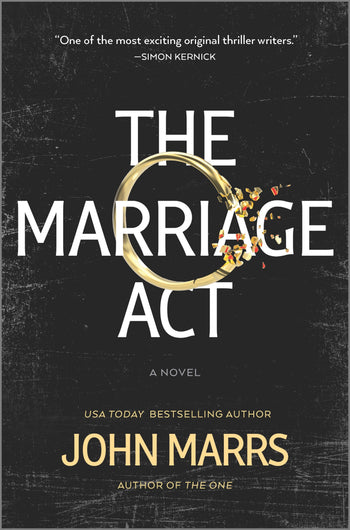
The Marriage Act PDF - John Marrs
John Marrs • science fiction novels • 432 Pages
(0)
Quate
Review
Save
Share
Book Description
The Marriage Act by John Marrs is a dark, high-concept near-future thriller that turns one of society’s most familiar institutions into a chilling instrument of control. Set in Britain in a future that feels disturbingly close to the present, the novel imagines a government that believes it has found the answer to social decline: the Sanctity of Marriage Act, a law designed to encourage marriage as the accepted norm while punishing those who choose to remain single. What begins as a policy built around stability, family values, and social improvement soon becomes something far more invasive, as private relationships are drawn into a system of surveillance, judgment, and coercion. (John Marrs - Author)
A Dystopian Thriller About Love, Power, and Surveillance
At the heart of The Marriage Act is a terrifying question: what happens when the state decides it knows what is best for love? Marrs builds the novel around four couples whose lives are pulled into a world where marriage is not simply a personal commitment, but a monitored social contract. In this version of Britain, the government supervises intimate relationships, tracks disagreements, observes behavior, and uses its authority to shape what people say, how they live, and whether their marriages are considered successful. The result is a story that blends domestic suspense, dystopian fiction, and psychological thriller into a sharp examination of privacy, obedience, and emotional control. (panmacmillan.com)
The brilliance of the premise lies in how ordinary it first appears. Marriage is familiar, respectable, and socially celebrated, which makes the law’s darker consequences feel even more unsettling. Marrs does not need to create a distant futuristic world filled with impossible technology; instead, he pushes existing concerns about surveillance, data, political messaging, and personal freedom just a few steps further. That closeness to reality gives The Marriage Act its strongest tension. Readers are not asked to fear a fantasy nightmare, but to consider how easily a society might accept intrusion if it were presented as protection, order, or moral improvement.
The Dark Future World of John Marrs
The Marriage Act belongs to John Marrs’s group of speculative novels often described as his Dark Future books. These stories share a connected universe but do not need to be read in order, allowing readers to begin with this novel even if they have not yet read The One, The Passengers, or The Minders. Marrs’s official site identifies these books as being set in the same universe while remaining accessible as standalone stories, which makes The Marriage Act a strong entry point for readers interested in his blend of suspense, technology, and social speculation. (John Marrs - Author)
Like Marrs’s earlier speculative fiction, The Marriage Act is not interested in technology for its own sake. Its real concern is human behavior under pressure. The novel asks whether people become more honest when monitored or simply learn to perform happiness. It asks whether a relationship can remain loving when every argument may have consequences beyond the home. It also explores the frightening possibility that systems designed to measure success may destroy the very intimacy they claim to protect. This makes the book especially compelling for readers who enjoy Black Mirror-style thrillers, social science fiction, and novels that turn modern anxieties into page-turning suspense.
A Story of Four Couples Under Pressure
The novel’s focus on four couples gives the story emotional range and narrative momentum. Each relationship becomes a different lens through which the reader can examine the cost of state-approved intimacy. Marrs uses these marriages to explore the gap between public appearance and private truth, between what couples show the world and what they hide from one another. In a society where the government is watching every minor disagreement, even ordinary tension becomes dangerous.
This structure allows The Marriage Act to work on two levels at once. On one level, it is a gripping thriller filled with secrets, pressure, and escalating consequences. On another, it is a social warning about the loss of private space. Marriage, in Marrs’s hands, becomes a stage on which larger questions are performed: Who benefits when personal life becomes measurable? What happens when nonconformity is punished? Can love survive when it is shaped by fear, financial pressure, and institutional approval?
Why The Marriage Act Appeals to Thriller Readers
Readers who enjoy psychological suspense will find much to admire in the way Marrs builds unease through relationships rather than relying only on external danger. The threat in The Marriage Act is not limited to a single villain or crime; it is embedded in policy, technology, and social expectation. That makes the novel feel larger than a traditional domestic thriller while still keeping the emotional intensity of secrets, betrayal, and private conflict.
For fans of dystopian thrillers, the book offers a plausible and uncomfortable future rooted in recognizable debates about government authority, personal liberty, artificial intelligence, and data-driven decision-making. For fans of domestic noir, it offers marriages filled with tension, compromise, fear, and hidden motives. For readers discovering John Marrs through The One, it delivers the same kind of provocative “what if” storytelling: a simple concept expanded into a morally complicated world where every choice carries consequences.
John Marrs’s Signature Blend of Pace and Provocation
John Marrs is known for novels that combine accessible prose, strong hooks, short chapters, and fast-moving plots with darker questions about the human mind. Before becoming a full-time writer in 2016, he worked as a freelance journalist, and his background in journalism shows in the clarity and pace of his storytelling. His official biography notes that he began as a self-published author, wrote his early books during his daily train commute, and later gained wide recognition with The One, which was translated into thirty-five languages, sold more than a million copies, and became a Netflix series. (John Marrs - Author)
That same instinct for bold concepts is clear in The Marriage Act. Marrs understands how to make an idea instantly readable without reducing its complexity. He gives readers a world that is easy to enter, then steadily reveals how frightening its rules really are. His style is direct, cinematic, and built for momentum, but the novel’s impact comes from more than twists. It comes from the discomfort of realizing that the book’s imagined future is built from concerns already present in contemporary life: surveillance, political polarization, social engineering, loneliness, and the pressure to appear successful.
A Thought-Provoking Near-Future Novel
The Marriage Act is especially effective because it turns a private promise into a public performance. The familiar phrase “love, honor and obey” becomes darker when obedience is no longer symbolic but enforced by systems of monitoring and punishment. Marrs uses this tension to question the difference between genuine commitment and state-approved conformity. His version of marriage is not merely romantic or domestic; it is economic, political, technological, and deeply personal.
The novel also speaks to readers interested in the ethics of artificial intelligence and social control. When a system claims to improve lives by collecting data and correcting behavior, the boundary between help and domination becomes dangerously thin. Marrs keeps that boundary at the center of the story, showing how easily good intentions, ideological certainty, and technological confidence can combine into something oppressive.
A Gripping Read for Fans of Dark Speculative Suspense
The Marriage Act by John Marrs is a powerful choice for readers looking for a dystopian psychological thriller with a sharp premise, fast pacing, and unsettling relevance. It offers the suspense of troubled relationships, the scale of speculative fiction, and the moral unease of a society where private life is no longer private. With its near-future British setting, its focus on four couples, and its frightening vision of government-supervised marriage, the novel stands out as one of Marrs’s most provocative explorations of love, freedom, and control.
For readers who enjoy thrillers that are both entertaining and uncomfortable, The Marriage Act delivers a story that is tense, intelligent, and difficult to dismiss. It asks not only whether marriage can survive pressure from within, but whether love can remain real when every word, disagreement, and choice is watched by someone else.
John Marrs
John Marrs is a British author best known for psychological thrillers and speculative fiction that turn ordinary fears into gripping, high-concept stories. His novels often begin with a question that feels simple, almost irresistible, and then push that question into darker emotional and ethical territory. What if science could identify the person you were genetically meant to love? What if driverless cars had to choose who lives and who dies? What if marriage became a monitored social institution with rewards, punishments, and state-approved rules? This is the kind of imaginative pressure that defines Marrs’s work: he takes familiar parts of modern life, moves them a few steps forward, and reveals how easily convenience, technology, and desire can become dangerous.
Before becoming a full-time author in 2016, Marrs worked as a freelance journalist, interviewing figures from television, film, and music for major national publications. He began as a self-published writer, drafting his first three books during his daily train commute. His debut novel, The Wronged Sons, was released in 2013, followed by Welcome to Wherever You Are in 2015. His breakthrough came with The One, released in 2017, which became a major bestseller, was translated into thirty-five languages, sold more than a million copies, and was adapted into a popular streaming series. His official biography separates his work into two broad strands: psychological thrillers such as When You Disappeared, The Good Samaritan, Her Last Move, What Lies Between Us, Keep It In The Family, The Stranger In Her House, and You Killed Me First; and speculative novels such as The One, The Passengers, The Minders, The Marriage Act, and The Family Experiment.
Marrs’s appeal lies in the way he combines commercial pace with unsettling moral questions. His chapters are usually short, sharp, and designed to keep the reader moving, but the best of his fiction is not only about twists. It is about pressure: pressure inside families, pressure inside relationships, pressure created by secrets, technology, class, ambition, shame, and fear. He writes characters who may seem ordinary at first, then gradually exposes the compromises, lies, and private wounds that shape their decisions. This makes his books especially attractive to readers who enjoy thrillers that are easy to enter but difficult to forget.
In his psychological suspense novels, Marrs often explores domestic spaces as places of danger. Homes, marriages, friendships, and family histories are not simply backgrounds; they become emotional battlegrounds. A locked room may matter less than a locked memory, and a crime may be less frightening than the relationship that made it possible. His speculative novels, by contrast, widen the lens. They examine social systems, scientific promises, and technological progress, but they remain grounded in human behavior. Even when the concept is futuristic, the emotions are recognizable: jealousy, loneliness, ambition, grief, love, and the need to belong.
This balance between the personal and the conceptual helps explain why John Marrs appeals to different kinds of readers. Fans of domestic noir can find betrayal, manipulation, and hidden motives in his thrillers. Readers of near-future fiction can find provocative ideas about data, artificial intelligence, relationships, and state control. Readers who simply want a page-turner can enjoy the pace, reversals, and cliffhangers. Yet beneath the entertainment value, Marrs repeatedly asks whether people become more honest when given better tools, or whether new systems merely give old impulses more power.
As an author, John Marrs has built a recognizable identity around accessible prose, bold premises, emotional tension, and dark social imagination. His work is popular because it understands a central anxiety of contemporary life: the things designed to protect, connect, or improve us may also expose what is most selfish, fearful, and fragile within us. For readers looking for modern thrillers with strong hooks, morally complicated characters, and ideas that linger after the final chapter, John Marrs is a distinctive and highly readable voice.
Earn Rewards While Reading!
Every 10 pages you read and spent 30 seconds on every page, earns you 5 reward points! Keep reading to unlock achievements and exclusive benefits.
Read
Rate Now
5 Stars
4 Stars
3 Stars
2 Stars
1 Stars
The Marriage Act Quotes
Top Rated
Latest
Quate
Be the first to leave a quote and earn 10 points
instead of 3
Other books by John Marrs
Other books like The Marriage Act
'%20/%3e%3c/svg%3e "Imprisoned with the Pharaohs")
3056
English
Comments
Be the first to leave a comment and earn 5 points
instead of 3