

The source of the book
This book is published for the public benefit under a Creative Commons license, or with the permission of the author or publisher. If you have any objections to its publication, please contact us.
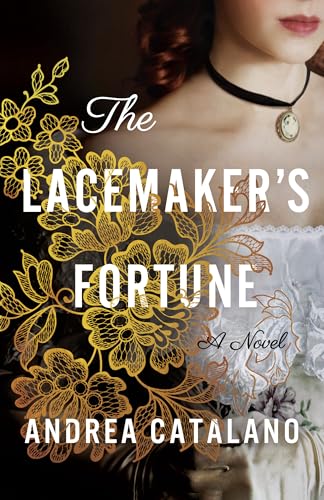
The Lacemaker's Fortune PDF - Andrea Catalano
Andrea Catalano • romantic novels • 381 Pages
(0)
Quate
Review
Save
Share
Book Description
Andrea Catalano is an American historical novelist whose work is defined by immersive research, emotionally charged storytelling, and a strong interest in women whose lives are shaped by class, ambition, love, danger, and social constraint. She is the author of The First Witch of Boston and The Lacemaker's Fortune: A Novel, two works that show her talent for transforming overlooked historical tensions into vivid, character-driven fiction. With an academic background in history and advanced historical studies, Catalano writes with a clear understanding of how the past is built not only from major public events, but also from private choices, domestic pressures, social expectations, labor, migration, faith, and desire. Her fiction appeals to readers who enjoy historical novels with strong atmosphere, complex relationships, moral conflict, and protagonists who must fight to define their own lives within worlds that rarely offer them easy freedom.
In The Lacemaker's Fortune: A Novel, Andrea Catalano turns her attention to the late nineteenth century and creates a richly textured story set against the restless background of the Gilded Age. The novel begins in New York City in 1879, where Eileen Maguire works as a factory lacemaker and dreams of escaping the limitations of poverty, exhausting labor, and narrow opportunity. Eileen’s skill with lace suggests artistry, patience, and refinement, yet her circumstances confine her to a life in which talent alone is not enough to guarantee independence. Her hopes for a better future are tied to family, work, and the possibility of owning a millinery shop, a dream that represents not only financial improvement but also dignity, self-determination, and a life shaped by her own hands. Through Eileen, Catalano explores the realities of working-class womanhood, the vulnerability of immigrant life, and the emotional force of ambition when survival and longing become inseparable.
The novel also introduces Lawrence Barnard, the heir to one of Manhattan’s wealthy families, whose privilege does not free him from confinement. While Eileen is restricted by poverty, Lawrence is restricted by expectation, status, inheritance, and the rigid rules of elite society. This contrast allows Andrea Catalano to examine class from more than one direction. Wealth offers comfort and influence, but it can also demand obedience, silence, and emotional compromise. When Eileen and Lawrence encounter the charismatic Stanley Jones, their lives become entangled in a dangerous promise of reinvention. Stanley speaks of opportunity in the American West, presenting Colorado as a place where old limits can be abandoned and new fortunes can be made. Yet Catalano understands that promises of freedom often conceal deeper forms of control, and what begins as an idealistic journey soon darkens into a story of seduction, manipulation, betrayal, and awakening.
The Lacemaker's Fortune: A Novel gains much of its power from its movement between desire and danger. Leadville, Colorado, a silver mining boomtown high in the Rocky Mountains, becomes more than a setting; it becomes a symbol of risk, illusion, greed, and transformation. The frontier offers the possibility of escape, but it also exposes hidden motives and intensifies the emotional conflicts among the characters. A love triangle emerges, shaped by passion, secrecy, unequal power, and competing dreams. Catalano uses this tension not simply for romance or suspense, but to ask deeper questions about agency, self-worth, and the cost of believing too completely in another person’s vision. Her characters are drawn toward fortune, love, and independence, yet they must eventually confront the painful truth that real freedom cannot be built on deception or surrender.
Andrea Catalano’s strength as a novelist lies in her ability to combine historical detail with psychological depth. She writes about clothing, work, cities, households, social rank, and migration in ways that help readers feel the texture of the period, but her true focus remains the inner lives of her characters. The Lacemaker's Fortune: A Novel is especially suited for readers who enjoy historical fiction with romance, suspense, class conflict, and strong female-centered storytelling. It presents the Gilded Age not merely as an era of wealth and spectacle, but as a time of sharp inequality, restless movement, and dangerous dreams. Through Eileen’s journey, Catalano gives readers a story about temptation, resilience, heartbreak, and the difficult discovery that a person’s fortune is not only money or status, but the courage to choose a life with open eyes.
Andrea Catalano
Andrea Catalano is a historical novelist whose work grows from a deep attachment to reading, research, memory, and the hidden lives of people caught inside powerful historical forces. Her literary identity is shaped by a long fascination with historical fiction and by serious academic training in history. This combination gives her writing a distinctive foundation: she approaches the past not merely as decoration or atmosphere, but as a living moral landscape where ordinary people face extraordinary pressures. In her fiction, history is not distant scenery. It becomes a field of conflict, emotion, belief, fear, loyalty, and survival.
Catalano’s background helps explain the seriousness of her chosen genre. She studied history as an undergraduate and later completed advanced work in historical studies at the University of Cambridge. That scholarly path is important because it suggests a writer who understands the value of archives, context, evidence, and historical complexity. Yet her purpose is not simply to reproduce research in fictional form. Rather, she appears interested in transforming research into human experience. The best historical fiction often depends on that balance: the world must feel accurate enough to trust, but intimate enough to move the reader. Catalano’s work stands at that meeting point between documented history and emotional imagination.
Her debut novel, The First Witch of Boston, focuses on Margaret Jones, remembered as the first woman in Massachusetts Bay Colony to be prosecuted, convicted, and executed for witchcraft in 1648. The novel also gives attention to Margaret’s husband, Thomas, which allows the story to explore not only accusation and punishment, but marriage, loyalty, fear, and the cost of standing near someone condemned by society. By choosing Margaret Jones as her subject, Catalano turns toward a figure who might otherwise remain flattened by legal records and historical summaries. She asks the kind of question that historical novelists are uniquely equipped to ask: what did such a life feel like from within?
Her writing can be described as attentive, humane, and historically conscious. She seems drawn to moments when private life is invaded by public suspicion, when belief systems harden into judgment, and when communities become dangerous because they are afraid. In that sense, her fiction is not only about the seventeenth century. It also speaks to broader patterns in human behavior: scapegoating, moral panic, social conformity, and the vulnerability of women whose knowledge, independence, or reputation made them targets. Catalano’s subject matter invites readers to consider how fear can become law, how rumor can become fate, and how history often preserves the accusation more clearly than the person accused.
Andrea Catalano’s authorial profile is also marked by patience and persistence. Her public biography presents writing historical fiction as a long-held dream rather than a sudden career choice. That matters because it gives her work the feeling of a sustained vocation. She writes as someone who has loved books for a long time and has allowed that love to mature through study, discipline, and craft. Her developing body of work suggests an author committed to recovering the emotional truth of the past, especially where women’s lives intersect with danger, silence, and judgment. Catalano is therefore best described as a novelist of historical restoration: a writer who uses fiction to return depth, dignity, and human complexity to people remembered too narrowly by history.
Earn Rewards While Reading!
Every 10 pages you read and spent 30 seconds on every page, earns you 5 reward points! Keep reading to unlock achievements and exclusive benefits.
Read
Rate Now
5 Stars
4 Stars
3 Stars
2 Stars
1 Stars
The Lacemaker's Fortune Quotes
Top Rated
Latest
Quate
Be the first to leave a quote and earn 10 points
instead of 3
'%20/%3e%3c/svg%3e "The First Witch of Boston")
Comments
Be the first to leave a comment and earn 5 points
instead of 3