

The source of the book
This book is published for the public benefit under a Creative Commons license, or with the permission of the author or publisher. If you have any objections to its publication, please contact us.
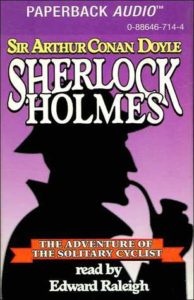
The Adventure of the Solitary Cyclist PDF - Arthur Conan Doyle
Arthur Conan Doyle • Crime novels and mysteries • 20 Pages
(0)
Quate
Review
Save
Share
Book Description
“The Adventure of the Solitary Cyclist” is a Sherlock Holmes short story by Arthur Conan Doyle, first published in the United States in Collier’s on December 26, 1903, and in Britain in The Strand Magazine in January 1904. It was later collected in The Return of Sherlock Holmes, published in book form in 1905 by George Newnes, Ltd. (A Written in English, the story belongs to Doyle’s famous detective canon and features Sherlock Holmes and Dr. John Watson investigating a strange case that begins not with a murder, but with a young woman’s fear of being silently followed along a country road.
The story centers on Miss Violet Smith, a music teacher whose life has recently changed after the death of her father. She comes to Baker Street to consult Sherlock Holmes because, while cycling between Chiltern Grange and the railway station near Farnham, she has repeatedly noticed a mysterious bearded man following her on a bicycle. He never approaches, speaks, or threatens her directly, but his constant presence alarms her. This unsettling image gives the story its title and creates one of the most memorable openings in The Return of Sherlock Holmes.
Violet explains that her troubles began when two men, Mr. Carruthers and Mr. Woodley, arrived from South Africa claiming to have known her late uncle, Ralph Smith. She is offered a well-paid position as a music teacher for Carruthers’s daughter at his country home. The salary is unusually generous, and although the offer seems respectable at first, Violet soon encounters the violent and offensive Woodley, whose behavior makes her deeply uncomfortable. Carruthers, by contrast, appears more refined and protective, yet Holmes immediately suspects that the situation is not as simple as it looks.
Holmes sends Watson to investigate the lonely road where Violet is followed. Watson observes the mysterious cyclist but fails to identify him, which frustrates Holmes, who wants more exact evidence. As the case develops, Holmes discovers that Violet is connected to a hidden inheritance. Her uncle in South Africa has died and left money that could pass to her, making her valuable to men who want to control her future. The mystery is therefore not only about a strange cyclist, but about greed, coercion, and the danger faced by a woman with little protection in an isolated setting.
The plot becomes more urgent when Holmes realizes that Violet may soon be in serious danger. Woodley and his associate, the disgraced clergyman Williamson, plan to force her into marriage so they can gain access to her fortune. Carruthers is also morally compromised, because he first joined the scheme, but he has fallen in love with Violet and no longer wants her harmed. The silent cyclist who follows her is revealed to be Carruthers himself, disguised and watching over her from a distance. His behavior seems frightening, but his purpose has become protective rather than predatory.
The climax occurs when Violet is abducted before Holmes and Watson can fully prevent the crime. Woodley and Williamson carry out a forced marriage ceremony, but Holmes arrives with Watson and Carruthers in time to expose the plot. A confrontation follows, and Carruthers shoots Woodley, though not fatally. Holmes later clarifies that the forced marriage has no legal validity because Williamson has no proper authority and the ceremony was performed under coercion. Violet is saved, and the criminal plan collapses.
“The Adventure of the Solitary Cyclist” is a compact but effective Sherlock Holmes mystery that combines detection with social tension. Arthur Conan Doyle uses the image of the lone cyclist to build suspense, while the solution turns on motives hidden beneath respectable appearances. The story is especially notable for its atmosphere: quiet roads, country houses, false guardians, and the vulnerability of a working woman caught between financial dependence and personal danger. As a Sherlock Holmes adventure, it showcases Holmes’s sharp reasoning, Watson’s loyal but imperfect fieldwork, and Doyle’s talent for turning an everyday situation into a case of deception, inheritance, and attempted exploitation.
Arthur Conan Doyle
Agatha Christie is one of the most influential and widely read writers in the history of detective fiction, a British author whose name has become almost synonymous with mystery, crime, suspense, and the perfectly constructed literary puzzle. Born in England in 1890, Christie developed a lifelong fascination with storytelling, human behavior, secrets, and the hidden motives that can lie beneath ordinary social life. Her fiction is famous for combining elegant simplicity with extraordinary technical control: a body is discovered, a group of suspects is gathered, motives begin to surface, and the truth remains carefully concealed until the final revelation reshapes everything the reader thought they understood. What makes Agatha Christie especially remarkable is not only the number of books she wrote, but the precision with which she transformed the detective story into a form of intellectual entertainment. Her novels invite readers to become investigators, to notice small details, to weigh testimony, to question appearances, and to discover that the most important clue is often hidden in plain sight. Christie created some of the most recognizable characters in world literature, especially Hercule Poirot and Miss Marple. Hercule Poirot, the Belgian detective with his orderly mind, careful manners, and famous reliance on psychological insight, represents the power of logic, method, and close observation. Miss Marple, by contrast, appears modest and gentle, yet her deep understanding of village life and human nature allows her to interpret crime through patterns of behavior she has seen before. Through these two figures, Christie showed that detection could be both rational and intuitive, both analytical and humane. Her most celebrated works include Murder on the Orient Express, And Then There Were None, The Murder of Roger Ackroyd, Death on the Nile, The A.B.C. Murders, and A Murder Is Announced. These books remain popular because they combine suspense with memorable settings: a snowbound train, an isolated island, a river steamer, a country house, a quiet village, or a seemingly respectable family gathering. Christie understood that a confined setting increases tension, forcing characters to reveal themselves under pressure while the reader searches for the pattern behind their lies. Her storytelling rarely depends on graphic violence; instead, it relies on atmosphere, misdirection, dialogue, motive, and timing. She also wrote for the stage, and The Mousetrap became one of the most famous long-running plays in theatre history, proving that her sense of suspense could work as powerfully before a live audience as it did on the page. Agatha Christie’s prose is clear, economical, and accessible, which partly explains her global appeal. Yet beneath that clarity is a highly disciplined narrative intelligence. She knew when to withhold information, when to plant a clue, when to allow a suspect to appear guilty, and when to overturn expectations without cheating the reader. Her work reflects the social world of twentieth-century Britain, including class, manners, domestic life, inheritance, travel, marriage, reputation, and the tensions between public respectability and private desire. For modern readers, Christie’s novels offer more than clever endings. They offer a portrait of how people hide shame, ambition, resentment, fear, and longing behind polite conversation. Her influence can be seen in countless crime novels, television series, films, and detective stories that continue to use and reinvent the classic mystery structure she perfected. For book websites, libraries, and readers searching for classic crime fiction, Agatha Christie remains an essential author. Her legacy rests on the rare combination of popularity, originality, craftsmanship, and enduring readability. Decades after her death, her stories continue to challenge, entertain, and surprise readers, confirming her place as the enduring queen of mystery fiction.
Earn Rewards While Reading!
Every 10 pages you read and spent 30 seconds on every page, earns you 5 reward points! Keep reading to unlock achievements and exclusive benefits.
Read
Rate Now
5 Stars
4 Stars
3 Stars
2 Stars
1 Stars
The Adventure of the Solitary Cyclist Quotes
Top Rated
Latest
Quate
Be the first to leave a quote and earn 10 points
instead of 3
Other books by Arthur Conan Doyle
Other books like The Adventure of the Solitary Cyclist
'%20/%3e%3c/svg%3e "The Harbinger: The Ancient Mystery that Holds the Secret of America's Future")
Jonathan Cahn.
Crime novels and mysteries
(0)
3009
English
Jonathan Cahn.
Crime novels and mysteries
(0)
2675
English
Comments
Be the first to leave a comment and earn 5 points
instead of 3