

The source of the book
This book is published for the public benefit under a Creative Commons license, or with the permission of the author or publisher. If you have any objections to its publication, please contact us.
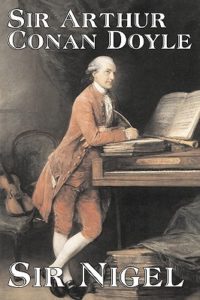
Sir Nigel PDF - Arthur Conan Doyle
Arthur Conan Doyle • Historical novels • 301 Pages
(0)
Quate
Review
Save
Share
Book Description
Arthur Conan Doyle’s Sir Nigel is a historical adventure novel first serialized in 1905–1906 and published in book form in January 1906. The first UK book edition was published by Smith, Elder & Co., while the first US book edition was issued by McClure, Phillips. Written by the Scottish author best known for creating Sherlock Holmes, Sir Nigel shows another side of Doyle’s literary interests: his fascination with medieval chivalry, English history, and the romance of armed service. The novel is set in the early phase of the Hundred Years’ War, roughly between 1350 and 1356, and serves as a prequel to Doyle’s earlier historical novel The White Company.
The story follows Nigel Loring, a young nobleman from Tilford in Surrey, who dreams of proving himself as a knight. Though he is small in build and gentle in manner, Nigel possesses a strong sense of honor, courage, and loyalty. He lives with his formidable grandmother, the Lady Ermyntrude, whose memories of noble lineage and martial glory shape his imagination. Nigel’s world is one of old family pride, strict codes of conduct, and a deep belief that a man must win his good name through action.
At the beginning of the novel, Nigel is not yet the celebrated warrior readers meet in The White Company. He is inexperienced, idealistic, and eager to enter the larger world beyond his estate. His ambitions are encouraged by the traditions of knighthood, but he must earn recognition through deeds rather than birth alone. Doyle presents him as a young man whose innocence is not weakness. Nigel’s politeness, faith, and romantic view of life coexist with a fierce determination to face danger.
A central thread of the plot is Nigel’s love for Mary, a young woman whose affection gives emotional purpose to his quest for honor. Their relationship is shaped by the ideals of courtly love: devotion, patience, and self-improvement. Nigel wants to become worthy of her by performing brave acts and gaining a reputation that will allow him to stand proudly before her. This romantic motivation blends with his desire to serve King Edward III and take part in the military campaigns in France.
As Nigel leaves home, the novel becomes a sequence of adventures that test his character. He encounters rough soldiers, proud nobles, religious figures, enemies, and common people whose lives reveal the mixed realities of medieval society. Doyle does not present the Middle Ages as peaceful or simple. The world of Sir Nigel contains brutality, poverty, violence, and superstition, but it is also filled with ceremony, loyalty, humor, and personal courage. Through Nigel’s eyes, readers see both the beauty and harshness of chivalric culture.
Nigel eventually enters the service of great military leaders and becomes involved in the English campaigns during the Hundred Years’ War. The novel includes tournaments, battles, sieges, and acts of personal combat, all written in a style that emphasizes movement, color, and heroic energy. Doyle’s battle scenes focus less on strategy than on individual bravery and the moral qualities revealed under pressure. Nigel repeatedly proves that courage is not a matter of size, wealth, or loud confidence. His quiet resolve allows him to face opponents who appear stronger or more worldly.
One of the important developments in the plot is Nigel’s gradual transformation from a sheltered young gentleman into a knight of real experience. He learns that honor is not merely a matter of appearance or noble language. It demands endurance, sacrifice, restraint, and loyalty to companions. His idealism is tested, but it is not destroyed. Instead, Doyle allows Nigel to grow while preserving the purity of purpose that makes him distinctive.
As a prequel to The White Company, Sir Nigel gives background to one of Doyle’s most memorable medieval heroes. It explains how Nigel Loring became known for valor and why his name carries weight in the later story. However, the novel can also be read independently as a coming-of-age adventure. Its appeal lies in its combination of romance, historical atmosphere, battlefield action, and moral simplicity.
Sir Nigel is not a Sherlock Holmes mystery, but it reflects Arthur Conan Doyle’s skill in creating memorable characters and vivid scenes. The novel offers readers a dramatic portrait of medieval knighthood and a young hero’s pursuit of honor during one of the most turbulent periods in English and French history. For readers interested in classic historical fiction, Arthur Conan Doyle’s Sir Nigel remains a lively and earnest story about courage, love, reputation, and the making of a knight.
Arthur Conan Doyle
Agatha Christie is one of the most influential and widely read writers in the history of detective fiction, a British author whose name has become almost synonymous with mystery, crime, suspense, and the perfectly constructed literary puzzle. Born in England in 1890, Christie developed a lifelong fascination with storytelling, human behavior, secrets, and the hidden motives that can lie beneath ordinary social life. Her fiction is famous for combining elegant simplicity with extraordinary technical control: a body is discovered, a group of suspects is gathered, motives begin to surface, and the truth remains carefully concealed until the final revelation reshapes everything the reader thought they understood. What makes Agatha Christie especially remarkable is not only the number of books she wrote, but the precision with which she transformed the detective story into a form of intellectual entertainment. Her novels invite readers to become investigators, to notice small details, to weigh testimony, to question appearances, and to discover that the most important clue is often hidden in plain sight. Christie created some of the most recognizable characters in world literature, especially Hercule Poirot and Miss Marple. Hercule Poirot, the Belgian detective with his orderly mind, careful manners, and famous reliance on psychological insight, represents the power of logic, method, and close observation. Miss Marple, by contrast, appears modest and gentle, yet her deep understanding of village life and human nature allows her to interpret crime through patterns of behavior she has seen before. Through these two figures, Christie showed that detection could be both rational and intuitive, both analytical and humane. Her most celebrated works include Murder on the Orient Express, And Then There Were None, The Murder of Roger Ackroyd, Death on the Nile, The A.B.C. Murders, and A Murder Is Announced. These books remain popular because they combine suspense with memorable settings: a snowbound train, an isolated island, a river steamer, a country house, a quiet village, or a seemingly respectable family gathering. Christie understood that a confined setting increases tension, forcing characters to reveal themselves under pressure while the reader searches for the pattern behind their lies. Her storytelling rarely depends on graphic violence; instead, it relies on atmosphere, misdirection, dialogue, motive, and timing. She also wrote for the stage, and The Mousetrap became one of the most famous long-running plays in theatre history, proving that her sense of suspense could work as powerfully before a live audience as it did on the page. Agatha Christie’s prose is clear, economical, and accessible, which partly explains her global appeal. Yet beneath that clarity is a highly disciplined narrative intelligence. She knew when to withhold information, when to plant a clue, when to allow a suspect to appear guilty, and when to overturn expectations without cheating the reader. Her work reflects the social world of twentieth-century Britain, including class, manners, domestic life, inheritance, travel, marriage, reputation, and the tensions between public respectability and private desire. For modern readers, Christie’s novels offer more than clever endings. They offer a portrait of how people hide shame, ambition, resentment, fear, and longing behind polite conversation. Her influence can be seen in countless crime novels, television series, films, and detective stories that continue to use and reinvent the classic mystery structure she perfected. For book websites, libraries, and readers searching for classic crime fiction, Agatha Christie remains an essential author. Her legacy rests on the rare combination of popularity, originality, craftsmanship, and enduring readability. Decades after her death, her stories continue to challenge, entertain, and surprise readers, confirming her place as the enduring queen of mystery fiction.
Earn Rewards While Reading!
Every 10 pages you read and spent 30 seconds on every page, earns you 5 reward points! Keep reading to unlock achievements and exclusive benefits.
Read
Rate Now
5 Stars
4 Stars
3 Stars
2 Stars
1 Stars
Sir Nigel Quotes
Top Rated
Latest
Quate
Be the first to leave a quote and earn 10 points
instead of 3
'%20/%3e%3c/svg%3e "The Poetry of Arthur Conan Doyle")
Comments
Be the first to leave a comment and earn 5 points
instead of 3