

The source of the book
This book is published for the public benefit under a Creative Commons license, or with the permission of the author or publisher. If you have any objections to its publication, please contact us.
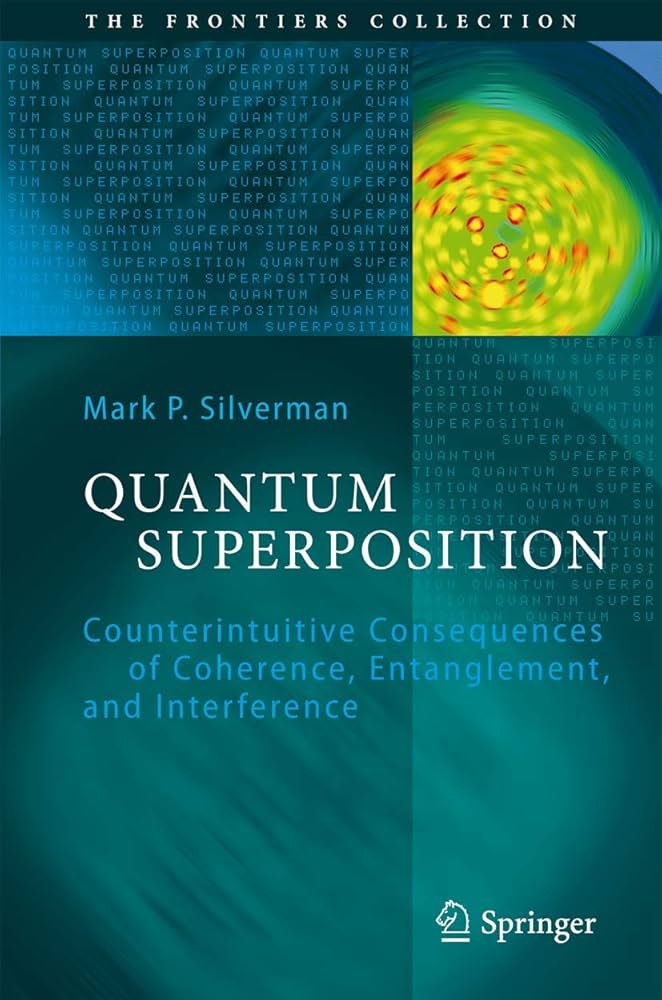
Quantum Superposition PDF - Mark P. Silverman
Mark P. Silverman • modern physics • 387 Pages
(0)
Author
Mark P. SilvermanCategory
Natural ScienceSection
Number Of Downloads
1
Number Of Reads
65
File Size
3.02 MB
Views
416
Quate
Review
Save
Share
Book Description
Quantum Superposition: Counterintuitive Consequences of Coherence, Entanglement, and Interference by Mark P. Silverman offers a compelling and accessible exploration of one of the most fundamental and mysterious principles of modern physics. Quantum superposition lies at the heart of phenomena such as coherence, entanglement, and interference—effects that challenge classical intuition and redefine our understanding of reality.
Drawing on decades of experimental and theoretical research, Silverman presents a clear and well-structured explanation of how quantum superposition governs a wide range of physical processes. The book examines the wave-like behavior of particles, the indistinguishability of identical quantum entities, and the nonlocal interactions that emerge between entangled particles. Through these topics, readers gain insight into how quantum systems behave in ways that defy everyday experience yet remain rigorously consistent with experimental evidence.
The author also explores the role of superposition in more advanced and intriguing contexts, including the influence of magnetic fields through topological effects and the origins of chiral asymmetry observed in nature. Moving beyond microscopic systems, Silverman investigates the possibility of macroscopic quantum coherence, considering how large-scale quantum effects may help address unresolved problems in physics—such as the collapse of massive stars into singularities where conventional physical laws cease to apply.
Written with a strong emphasis on clarity and experimental relevance, the book avoids unnecessary mathematical complexity while remaining scientifically precise. Silverman’s approachable style makes sophisticated quantum concepts understandable to advanced students, researchers, and scientifically curious readers alike.
Mark P. Silverman
Mark P. Silverman is an American physicist, author, and educator whose career spans experimental and theoretical research across atomic physics, quantum mechanics, optics, astrophysics, and applied statistics. He earned his Ph.D. in Physics from Harvard University, fulfilling a lifelong ambition inspired in childhood by the writings of James Jeans, Arthur Eddington, and George Gamow. From an early age, Silverman was fascinated by the fundamental laws governing nature, a curiosity that shaped a long and unusually wide-ranging scientific career.
Silverman began his research in atomic physics, developing innovative experimental methods to study short-lived excited quantum states in neutral atoms. His early work on hydrogen—the simplest atom—contributed to precision tests of quantum electrodynamics (QED), one of the most accurate theories in all of science. Alongside his experimental work, he pursued ambitious theoretical research, including a significant generalization of the theory of separated oscillatory fields for finite-lived excited states, building on the Nobel Prize–winning work of Norman Ramsey. These investigations were later synthesized in his book Probing the Atom (Princeton University Press, 2000).
Quantum physics became a central theme of Silverman’s career. He explored quantum interference, superposition, and coherence using diverse techniques such as electron interferometry, spectroscopy, and electron microscopy. While serving as Visiting Chief Researcher at the Hitachi Advanced Research Laboratory in Japan, he proposed a landmark experiment demonstrating the buildup of an electron interference pattern one electron at a time—later voted the “most beautiful experiment in physics” by Physics World. His insights into quantum mechanics are presented in More Than One Mystery (1995) and Quantum Superposition (2008).
In optics, Silverman made notable contributions to the study of polarized light, chirality, and lensless diffractive imaging, with applications in biology, medicine, and materials science. He documented this work in Waves and Grains (1998). From the 2000s onward, his research expanded into astrophysics and nuclear physics, addressing dark matter, dark energy, stellar collapse, and radioactive decay.
Later in his career, Silverman developed a deep interest in statistics and randomness, applying stochastic methods to physics and real-world systems. This culminated in his seventh book, A Certain Uncertainty: Nature’s Random Ways (Cambridge University Press, 2015). Known for his intellectual independence and interdisciplinary curiosity, Mark P. Silverman remains a compelling voice in modern physics, emphasizing that the universe is governed by comprehensible natural laws rather than superstition or myth.
Earn Rewards While Reading!
Every 10 pages you read and spent 30 seconds on every page, earns you 5 reward points! Keep reading to unlock achievements and exclusive benefits.
Read
Rate Now
5 Stars
4 Stars
3 Stars
2 Stars
1 Stars
Quantum Superposition Quotes
Top Rated
Latest
Quate
Be the first to leave a quote and earn 10 points
instead of 3
Other books by Mark P. Silverman
Other books like Quantum Superposition
'%20/%3e%3c/svg%3e "Quantum Mechanics with Applications to Nanotechnology and Information Science")
Yshai Avishai.
modern physics
(0)
1889
English
2091
English
Comments
Be the first to leave a comment and earn 5 points
instead of 3