

The source of the book
This book is published for the public benefit under a Creative Commons license, or with the permission of the author or publisher. If you have any objections to its publication, please contact us.
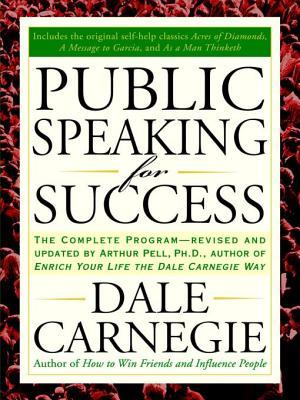
Public Speaking for Success PDF - Dale Carnegie
Dale Carnegie • Human Development • 444 Pages
(0)
Quate
Review
Save
Share
Book Description
Public Speaking for Success by Dale Carnegie is a practical and enduring guide for anyone who wants to speak with more confidence, clarity, and influence. Built around Carnegie’s belief that effective communication can be learned through steady practice, preparation, and courage, this book offers a complete approach to mastering one of the most valuable personal and professional skills: the ability to stand before others and express ideas persuasively. The modern edition is connected to Carnegie’s earlier public-speaking work, first developed in 1926 and later revised in shortened versions before being updated for contemporary readers.
A Classic Guide to Confidence, Communication, and Influence
At the heart of Public Speaking for Success is a simple but powerful idea: great speakers are not born fully formed; they are trained through attention, repetition, and experience. Carnegie approaches public speaking not as a performance reserved for naturally gifted people, but as a practical skill that can help ordinary readers improve their careers, relationships, leadership ability, and self-confidence. His method focuses on removing fear, organizing thoughts, using natural expression, and speaking in a way that keeps an audience awake, interested, and ready to act.
This book is especially valuable because it combines public speaking techniques with Carnegie’s broader philosophy of self-improvement. Readers familiar with How to Win Friends and Influence People will recognize the same emphasis on sincerity, audience awareness, enthusiasm, and human connection. Instead of treating speech as a mechanical exercise in memorization or polished delivery, Carnegie teaches that successful speaking begins with a real desire to communicate something meaningful. The result is a guide that feels both instructional and motivating, offering advice that applies to business presentations, classroom speeches, professional meetings, interviews, sales conversations, leadership roles, and everyday communication.
What Public Speaking for Success Teaches
Public Speaking for Success guides readers through the foundations of effective speech: how to develop courage before an audience, how to prepare a talk, how to improve memory, how to open and close a presentation, how to make ideas clear, and how to persuade listeners without sounding artificial. The book also gives attention to diction, speech exercises, and the practical habits that help speakers improve over time. The revised edition preserves Carnegie’s original range of methods, including speech and diction exercises following the chapters, while also restoring appendices that include classic inspirational essays selected for their value to readers.
Carnegie’s teaching style is direct, encouraging, and grounded in repeated action. He does not simply tell readers to “be confident”; he explains how confidence grows from preparation, familiarity with the subject, and the willingness to practice in realistic conditions. He shows that nervousness is not a permanent weakness, but a natural reaction that can be redirected into energy and presence. For readers searching for a book on overcoming fear of public speaking, this approach remains one of the strongest reasons to read Carnegie’s work.
Practical Public Speaking for Real Situations
One of the most useful qualities of Public Speaking for Success is its focus on real-world communication rather than abstract theory. Carnegie understands that most readers need to speak in practical settings: before colleagues, clients, students, committees, customers, community groups, or professional audiences. His advice helps readers think about the purpose of a speech, the needs of the audience, and the importance of choosing examples that make ideas memorable. The book encourages speakers to avoid dullness, speak with conviction, and make every presentation feel alive.
This makes the book highly relevant for anyone looking for a public speaking book for business, a communication skills guide, or a practical manual for improving presentations. Carnegie’s lessons can help readers structure a message, hold attention, speak naturally, and make their words more persuasive. Whether the goal is to give a formal presentation, lead a meeting, deliver a toast, pitch an idea, teach a lesson, or speak confidently in front of a small group, the principles in this book can be applied step by step.
Building Self-Confidence Through Preparation
Carnegie places strong emphasis on preparation, but not in the narrow sense of memorizing every word. Instead, he teaches readers to understand their subject deeply enough that they can speak with flexibility and conviction. This kind of preparation helps reduce anxiety because the speaker is not depending on a fragile script; they are relying on knowledge, structure, and genuine interest. For Carnegie, confidence is built by doing: preparing, speaking, receiving experience, and improving with each attempt.
This message is one of the reasons Public Speaking for Success continues to appeal to students, professionals, entrepreneurs, leaders, and anyone who feels held back by nervousness. The book treats fear as something that can be trained, not something that defines the speaker. Readers who want to develop self-confidence in public speaking will find a practical framework for turning hesitation into action and uncertainty into poise.
A Book for Students, Professionals, and Lifelong Learners
Public Speaking for Success is suitable for a wide range of readers. Students can use it to improve classroom presentations, debates, interviews, and academic confidence. Professionals can apply it to business meetings, sales presentations, networking events, leadership communication, and client-facing roles. Entrepreneurs and managers can use Carnegie’s principles to explain ideas more persuasively, inspire teams, and communicate with greater authority. Readers interested in personal development will also find the book useful because public speaking, in Carnegie’s view, strengthens discipline, courage, memory, and the ability to think clearly under pressure.
The book is also valuable for readers who want a classic alternative to modern presentation manuals. While many contemporary books focus on slides, branding, or performance style, Carnegie focuses on the deeper foundations of communication: courage, preparation, sincerity, structure, audience interest, and persuasive expression. These principles remain useful even when the speaking environment changes from a lecture hall to a boardroom, from a stage to a video call, or from a formal speech to an important conversation.
Why Dale Carnegie’s Approach Still Matters
Dale Carnegie’s lasting influence comes from his ability to make personal growth feel practical and attainable. He writes for readers who may doubt themselves, fear criticism, or believe that public speaking is beyond their reach. Rather than presenting communication as a mysterious talent, he breaks it into habits that can be practiced: know your material, organize your message, speak with energy, respect your listeners, use clear language, and improve through repetition. This approach gives the book a timeless quality because the human challenges of speaking—fear, uncertainty, attention, persuasion, and connection—remain the same across generations.
The revised edition of Public Speaking for Success was published by Tarcher/Penguin and is presented as a complete program that updates Carnegie’s language and references while preserving the original ideas and methods. It includes Carnegie’s public-speaking instruction along with exercises and additional inspirational material, making it more than a simple motivational text.
A Lasting Guide to Speaking with Purpose
Public Speaking for Success is more than a manual for giving speeches; it is a guide to becoming a clearer, braver, and more effective communicator. Dale Carnegie shows that speaking well is not about sounding perfect or impressing people with polished language. It is about connecting with an audience, expressing ideas with confidence, and learning how to move listeners through clarity, enthusiasm, and sincerity.
For readers searching for a Dale Carnegie public speaking book, a guide to effective communication, or a practical resource for overcoming stage fright and speaking with confidence, this book offers a structured and encouraging path. Its lessons are useful for anyone who wants to present ideas more clearly, lead with more presence, or communicate in a way that earns attention and respect. Through its combination of classic wisdom, practical exercises, and motivational guidance, Public Speaking for Success remains a meaningful resource for readers who want to turn public speaking from a source of fear into a source of personal and professional strength.
Dale Carnegie
Dale Carnegie is one of the most influential American authors, lecturers, and self-improvement pioneers of the twentieth century, best known for “How to Win Friends and Influence People,” a landmark book that helped define the modern language of communication, persuasion, leadership, confidence, and human relations. Born in 1888 in rural Missouri as Dale Carnagey, he came from modest farming roots and developed an early understanding of ambition, insecurity, social aspiration, and the powerful need people have to be noticed, respected, and valued. Carnegie’s rise was not immediate or effortless. He studied at what is now the University of Central Missouri, worked in sales, tried acting, and experienced the uncertainty familiar to many people attempting to build a public career. Those struggles became central to his later credibility: he did not write as a distant theorist, but as a practical teacher who understood fear of failure, fear of public speaking, and the everyday difficulty of dealing with customers, colleagues, employers, families, and strangers. His breakthrough came through teaching public speaking classes, especially in New York, where he discovered that adults enrolled not merely to improve their voices or gestures, but to become braver, more persuasive, and more comfortable in human interaction. From those classes grew the Dale Carnegie Course and the broader method that would make his name famous. Carnegie believed that successful communication begins with genuine interest in other people. Instead of urging readers to dominate conversations, display superiority, or win arguments through force, he taught them to listen, appreciate, remember names, avoid needless criticism, admit mistakes, and help others feel important. In 1936, “How to Win Friends and Influence People” turned those principles into one of the most enduring self-help books ever published. Its structure is memorable because it presents advice through stories, examples, and simple rules rather than abstract philosophy. Carnegie’s principles—do not criticize, condemn, or complain; give honest appreciation; arouse in the other person an eager want; become genuinely interested in others; smile; be a good listener; talk in terms of the other person’s interests—remain widely quoted because they address ordinary situations with unusual clarity. His later book “How to Stop Worrying and Start Living” expanded his influence from social success to emotional resilience. In that work, Carnegie encouraged readers to live in “day-tight compartments,” analyze worries clearly, accept possible outcomes mentally, and keep the mind engaged in useful action rather than helpless rumination. He also wrote about Abraham Lincoln in “Lincoln the Unknown” and produced important work on public speaking and business influence. Carnegie’s style can seem simple, but its simplicity is deliberate: he translated observations about pride, fear, ego, courtesy, and encouragement into techniques ordinary readers could apply immediately. His legacy continues through Dale Carnegie Training programs in leadership, sales, communication, and professional confidence, while his books remain fixtures in business, personal development, and motivational reading. Dale Carnegie matters because he helped millions of readers see that success is not only a matter of intelligence or talent; it is also a matter of empathy, tact, disciplined speech, emotional self-control, and the ability to make other people feel genuinely seen.
Earn Rewards While Reading!
Every 10 pages you read and spent 30 seconds on every page, earns you 5 reward points! Keep reading to unlock achievements and exclusive benefits.
Read
Rate Now
5 Stars
4 Stars
3 Stars
2 Stars
1 Stars
Public Speaking for Success Quotes
Top Rated
Latest
Quate
Be the first to leave a quote and earn 10 points
instead of 3
Other books by Dale Carnegie
'%20/%3e%3c/svg%3e "How to Win Friends and Influence People in the Digital Age")
3941
English
49108
English
Comments
Be the first to leave a comment and earn 5 points
instead of 3