

The source of the book
This book is published for the public benefit under a Creative Commons license, or with the permission of the author or publisher. If you have any objections to its publication, please contact us.
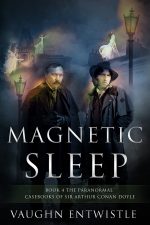
Magnetic Sleep PDF - Arthur Conan Doyle
Arthur Conan Doyle • Crime novels and mysteries • 219 Pages
(0)
Quate
Review
Save
Share
Book Description
Although the requested author is listed as Arthur Conan Doyle, Magnetic Sleep is not a novel written by Doyle. It is a historical paranormal mystery by Vaughn Entwistle, published in 2021 by Masque Publishing. The full title is Magnetic Sleep: Book 4 The Paranormal Casebooks of Sir Arthur Conan Doyle, and Arthur Conan Doyle appears as a fictionalized central character rather than as the author. Bibliographic listings identify Vaughn Entwistle as the author, with publication dated June 22, 2021.
Magnetic Sleep places the famous creator of Sherlock Holmes inside an atmospheric Victorian adventure that blends detective fiction, occult intrigue, and historical fantasy. Set during a hot London summer, the novel begins with a disturbing social panic that newspapers call “Sleepwalking Hysteria.” Young women from respectable homes are found wandering through the city in a trance-like state. Some commit crimes such as burglary and arson, while others disappear entirely. The title refers to nineteenth-century ideas of mesmerism and hypnotic influence, a theme that suits both the period setting and the novel’s supernatural tone.
The plot follows Arthur Conan Doyle and Oscar Wilde as they become involved in the strange case after witnessing a sleepwalking woman in danger. Their attempt to save her ends tragically, drawing them deeper into a mystery that seems to connect medical science, spiritualism, criminal manipulation, and London’s hidden underworld. As the incidents multiply, the two men confront the possibility that the sleepwalkers are not acting by their own will. Someone, or something, appears to be using them as tools for a larger and more sinister purpose.
Entwistle’s novel uses real cultural anxieties of the late Victorian era: fascination with hypnosis, fear of moral corruption, and the growing public appetite for sensational crimes. Doyle’s fictional role is especially fitting because the real Arthur Conan Doyle was both a rational storyteller and, later in life, a strong believer in spiritualism. In Magnetic Sleep, this contrast helps shape the investigation. Doyle approaches the case with curiosity and moral seriousness, while Wilde adds wit, social observation, and theatrical intelligence. Their partnership gives the story much of its energy.
As a mystery, Magnetic Sleep is built around the question of control. The sleepwalkers appear innocent, yet their actions are dangerous. The crimes suggest planning, but the visible perpetrators seem unaware of their behavior. This creates a plot in which the investigators must look beyond ordinary guilt and ask who benefits from the strange outbreak. The novel’s suspense comes from the collision between respectable London society and the darker possibilities of mesmerism, coercion, and hidden exploitation.
For readers searching for a Sherlock Holmes-style mystery actually written by Arthur Conan Doyle, this is not that book. However, for readers interested in Victorian paranormal fiction, literary-historical adventure, and stories that turn Doyle himself into a detective figure, Magnetic Sleep offers a dramatic and eerie entry in Vaughn Entwistle’s Paranormal Casebooks of Sir Arthur Conan Doyle series. Goodreads and other listings identify it as the fourth primary work in that series.
Arthur Conan Doyle
Agatha Christie is one of the most influential and widely read writers in the history of detective fiction, a British author whose name has become almost synonymous with mystery, crime, suspense, and the perfectly constructed literary puzzle. Born in England in 1890, Christie developed a lifelong fascination with storytelling, human behavior, secrets, and the hidden motives that can lie beneath ordinary social life. Her fiction is famous for combining elegant simplicity with extraordinary technical control: a body is discovered, a group of suspects is gathered, motives begin to surface, and the truth remains carefully concealed until the final revelation reshapes everything the reader thought they understood. What makes Agatha Christie especially remarkable is not only the number of books she wrote, but the precision with which she transformed the detective story into a form of intellectual entertainment. Her novels invite readers to become investigators, to notice small details, to weigh testimony, to question appearances, and to discover that the most important clue is often hidden in plain sight. Christie created some of the most recognizable characters in world literature, especially Hercule Poirot and Miss Marple. Hercule Poirot, the Belgian detective with his orderly mind, careful manners, and famous reliance on psychological insight, represents the power of logic, method, and close observation. Miss Marple, by contrast, appears modest and gentle, yet her deep understanding of village life and human nature allows her to interpret crime through patterns of behavior she has seen before. Through these two figures, Christie showed that detection could be both rational and intuitive, both analytical and humane. Her most celebrated works include Murder on the Orient Express, And Then There Were None, The Murder of Roger Ackroyd, Death on the Nile, The A.B.C. Murders, and A Murder Is Announced. These books remain popular because they combine suspense with memorable settings: a snowbound train, an isolated island, a river steamer, a country house, a quiet village, or a seemingly respectable family gathering. Christie understood that a confined setting increases tension, forcing characters to reveal themselves under pressure while the reader searches for the pattern behind their lies. Her storytelling rarely depends on graphic violence; instead, it relies on atmosphere, misdirection, dialogue, motive, and timing. She also wrote for the stage, and The Mousetrap became one of the most famous long-running plays in theatre history, proving that her sense of suspense could work as powerfully before a live audience as it did on the page. Agatha Christie’s prose is clear, economical, and accessible, which partly explains her global appeal. Yet beneath that clarity is a highly disciplined narrative intelligence. She knew when to withhold information, when to plant a clue, when to allow a suspect to appear guilty, and when to overturn expectations without cheating the reader. Her work reflects the social world of twentieth-century Britain, including class, manners, domestic life, inheritance, travel, marriage, reputation, and the tensions between public respectability and private desire. For modern readers, Christie’s novels offer more than clever endings. They offer a portrait of how people hide shame, ambition, resentment, fear, and longing behind polite conversation. Her influence can be seen in countless crime novels, television series, films, and detective stories that continue to use and reinvent the classic mystery structure she perfected. For book websites, libraries, and readers searching for classic crime fiction, Agatha Christie remains an essential author. Her legacy rests on the rare combination of popularity, originality, craftsmanship, and enduring readability. Decades after her death, her stories continue to challenge, entertain, and surprise readers, confirming her place as the enduring queen of mystery fiction.
Earn Rewards While Reading!
Every 10 pages you read and spent 30 seconds on every page, earns you 5 reward points! Keep reading to unlock achievements and exclusive benefits.
Read
Rate Now
5 Stars
4 Stars
3 Stars
2 Stars
1 Stars
Magnetic Sleep Quotes
Top Rated
Latest
Quate
Be the first to leave a quote and earn 10 points
instead of 3
Other books by Arthur Conan Doyle
Other books like Magnetic Sleep
'%20/%3e%3c/svg%3e "The Harbinger: The Ancient Mystery that Holds the Secret of America's Future")
Jonathan Cahn.
Crime novels and mysteries
(0)
3007
English
Jonathan Cahn.
Crime novels and mysteries
(0)
2671
English
Comments
Be the first to leave a comment and earn 5 points
instead of 3