

The source of the book
This book is published for the public benefit under a Creative Commons license, or with the permission of the author or publisher. If you have any objections to its publication, please contact us.
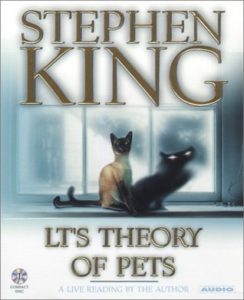
LT's Theory of Pets PDF - Stephen King
Stephen King • short stories • 19 Pages
(0)
Quate
Review
Save
Share
Book Description
Stephen King’s “L.T.’s Theory of Pets” is a short horror story rather than a full-length novel. It was first published in 1997 in King’s limited-edition collection Six Stories, published by Philtrum Press, and later appeared in the 2002 collection Everything’s Eventual, published by Scribner. A standalone audio edition was released in 2001 by Simon & Schuster Audio, read by Stephen King himself.
“L.T.’s Theory of Pets” by Stephen King is a compact, emotionally sharp story that blends domestic comedy, marital sadness, and psychological horror. The story centers on L.T. DeWitt, a working-class man whose memories of his failed marriage are filtered through his strange but memorable “theory” about pets. On the surface, the story sounds almost comic: a husband and wife give each other animals as anniversary gifts, only to discover that the pets seem to choose the “wrong” owners. Beneath that humor, however, Stephen King builds a quiet sense of loss, unease, and unresolved terror.
L.T. tells the story of his marriage to Lulubelle, often called Lulu. For their first anniversary, Lulu gives L.T. a dog named Frank. The gift should be affectionate, but Frank immediately dislikes L.T. and bonds with Lulu instead. Later, L.T. gives Lulu a Siamese cat named Lucy, but the same problem happens in reverse: Lucy rejects Lulu and becomes attached to L.T. The animals themselves are not monsters, and their rivalry is not the real problem. In fact, Frank and Lucy get along better than the married couple. This irony becomes the heart of L.T.’s theory: when a dog and cat can live together more peacefully than a husband and wife, the marriage is probably in serious trouble.
As L.T. retells these memories, the story is funny in a dry, bitter way. King uses the pets to reveal the couple’s deeper frustrations. Frank and Lucy become symbols of resentment, jealousy, miscommunication, and emotional distance. L.T. and Lulu are not presented as evil people; they are simply two people who no longer know how to live comfortably together. Their arguments over the pets reflect a relationship that has already begun to break apart.
The story darkens when Lulu leaves L.T. She writes a note saying that she has gone, taking Frank with her and leaving Lucy behind. At first, this seems like the sad but ordinary end of a marriage. Yet King slowly reveals that Lulu’s departure may not have been simple at all. She never reaches her intended destination, and her disappearance becomes connected to a violent threat outside the marriage. Her car is found, Frank is dead, and Lulu is missing. The story does not offer complete certainty, which makes the ending more disturbing. L.T. continues to hope that Lulu may still be alive, even though the evidence suggests something terrible happened.
The power of “L.T.’s Theory of Pets” comes from this shift in tone. What begins as a humorous story about pets and married life becomes a painful account of grief and denial. L.T.’s jokes and repeated theory are not just entertainment; they are a way of avoiding the unbearable truth. Stephen King’s story is effective because the horror does not arrive through supernatural events, but through ordinary life collapsing into mystery, guilt, and loss.
For readers interested in Stephen King’s short fiction, “L.T.’s Theory of Pets” is a strong example of his ability to turn everyday relationships into suspense. It is not one of his large-scale horror epics, but it shows his skill with voice, character, emotional tension, and the frightening uncertainty that can remain after someone disappears.
Stephen King
Stephen King is an American author best known for his contributions to the horror, supernatural fiction, and suspense genres. He was born in Portland, Maine in 1947 and began his writing career as a teenager, submitting short stories to various magazines. After graduating from college, King worked as a teacher while continuing to write in his spare time. His breakthrough novel, "Carrie," was published in 1974 and became a bestseller, launching his career as a full-time writer.
King is known for his prolific output, having written over 60 novels and 200 short stories throughout his career. Many of his books have been adapted into successful films and TV series, such as "The Shining," "It," and "The Stand." He has also won numerous awards for his work, including the Bram Stoker Award, the World Fantasy Award, and the National Medal of Arts.
King's writing style is characterized by his ability to create vivid and often terrifying imagery, as well as his focus on exploring the darkest aspects of the human psyche. He has tackled a wide range of subjects in his work, from the supernatural and the paranormal to more grounded themes such as addiction, family dynamics, and the struggles of everyday life.
Despite his success, King has also faced criticism for the often graphic and violent content of his work. Nevertheless, he remains one of the most popular and influential writers of his generation, with legions of fans around the world eagerly awaiting his next release.
In addition to his writing, King has also been an advocate for various causes, including freedom of expression and gun control. He has been active on social media, often sharing his thoughts on current events and engaging with his fans.
Earn Rewards While Reading!
Every 10 pages you read and spent 30 seconds on every page, earns you 5 reward points! Keep reading to unlock achievements and exclusive benefits.
Read
Rate Now
5 Stars
4 Stars
3 Stars
2 Stars
1 Stars
LT's Theory of Pets Quotes
Top Rated
Latest
Quate
Be the first to leave a quote and earn 10 points
instead of 3
'%20/%3e%3c/svg%3e "Carrie")
Comments
Be the first to leave a comment and earn 5 points
instead of 3