

The source of the book
This book is published for the public benefit under a Creative Commons license, or with the permission of the author or publisher. If you have any objections to its publication, please contact us.
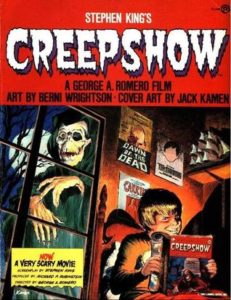
Creepshow PDF - Stephen King
Stephen King • Horror novels • 131 Pages
(0)
Quate
Review
Save
Share
Book Description
Stephen King’s Creepshow is a graphic novella first released in July 1982 by Plume, an imprint of Penguin Books. Written by Stephen King and illustrated by Bernie Wrightson, with coloring by Michele Wrightson and cover art by Jack Kamen, the book adapts the 1982 horror anthology film Creepshow, which was directed by George A. Romero and written by King. The work is not a conventional novel but a comic-book-style horror collection designed as a tribute to the lurid, moralistic, and darkly comic horror comics of the 1950s. A later trade paperback edition was published by Gallery 13 in 2017, presenting the same cult horror material for modern readers.
Creepshow is built around five separate tales of terror, each one using a bold visual style, exaggerated emotions, and cruelly ironic endings. Rather than following a single continuous plot, the book offers a sequence of compact horror stories linked by their shared tone: the guilty are punished, the foolish are destroyed, and ordinary settings become gateways to grotesque nightmares. King’s writing gives the stories their sharp pulp energy, while Wrightson’s illustrations make the book feel like a rediscovered horror comic from an earlier era.
The first story, “Father’s Day,” centers on a wealthy and deeply unpleasant family gathering to mark an annual ritual connected to the murder of Nathan Grantham, a tyrannical patriarch. Years earlier, Nathan was killed by his daughter after years of cruelty, but the family’s attempt to bury the past does not keep it dead. The tale turns a family celebration into a revenge story, using dark humor and corpse-horror to show how greed, resentment, and violence can return in physical form.
“The Lonesome Death of Jordy Verrill” follows a rural man who discovers a meteorite after it lands near his home. Believing the object might be valuable, Jordy handles it carelessly, only to unleash a strange alien growth. What begins as a simple fantasy of quick money becomes a body-horror tragedy. The story is based on King’s earlier short story “Weeds,” and it captures one of King’s familiar themes: disaster often begins when an ordinary person makes one foolish but understandable choice.
“Something to Tide You Over” shifts into a colder and more deliberate kind of horror. Richard Vickers, a jealous and calculating husband, takes revenge on his wife and her lover by burying them up to their necks on a beach and leaving them to drown as the tide comes in. The story’s suspense comes from Richard’s cruelty and confidence, but Creepshow follows the old horror-comic rule that sadists rarely escape justice. The result is a grimly satisfying tale of supernatural payback.
“The Crate” is one of the strongest and most memorable segments. It begins when an old wooden crate is found beneath a university staircase. Inside is a savage creature that has somehow survived for many years. The discovery becomes especially dangerous when a frustrated professor sees the monster not only as a threat but also as a possible solution to his miserable marriage. This story combines academic setting, monster horror, and domestic resentment, turning hidden violence into literal appetite. “The Crate” was based on King’s 1979 short story of the same name.
The final story, “They’re Creeping Up on You,” focuses on Upson Pratt, a wealthy, cruel, and obsessive businessman who lives in a sealed apartment and despises both people and insects. His sterile world becomes a trap when cockroaches begin to invade it. The story uses revulsion and claustrophobia to attack arrogance, control, and moral emptiness. Like several pieces in Creepshow, it ends with a punishment that is both horrifying and darkly comic.
As a book, Creepshow is best understood as a visual horror anthology rather than a standard Stephen King novel. Its appeal lies in its fast pacing, comic-book structure, and gleeful sense of poetic justice. King supplies the macabre imagination and narrative twists, while Bernie Wrightson’s artwork gives the stories their rotting textures, expressive faces, and vintage horror atmosphere. For readers interested in Stephen King’s work beyond prose fiction, Creepshow remains an important tie-in: a compact, stylish, and nasty collection that preserves the spirit of the 1982 film while standing as a vivid horror comic in its own right.
Stephen King
Stephen King is one of the most influential, widely read, and culturally recognizable authors in modern popular literature, celebrated above all for his mastery of horror while also making major contributions to suspense, crime fiction, fantasy, science fiction, psychological drama, and literary storytelling. Born in Portland, Maine, he developed a fictional world deeply connected to small towns, working families, childhood fears, buried secrets, and the unsettling possibility that ordinary life can suddenly open into terror. His work is often associated with supernatural forces, haunted places, violent outsiders, and monstrous presences, yet his lasting power comes from a deeper understanding of human weakness, grief, addiction, memory, loyalty, cruelty, and moral choice. King does not simply frighten readers; he invites them into fully imagined communities where fear grows naturally from character, atmosphere, and emotional truth.
Stephen King’s breakthrough came with Carrie, a novel that transformed the pain of adolescence, social rejection, religious fanaticism, and uncontrolled power into a compact and unforgettable story. The success of that book allowed him to become a full-time writer, and it was followed by a remarkable series of major works including Salem’s Lot, The Shining, The Stand, The Dead Zone, Cujo, Pet Sematary, It, Misery, The Green Mile, Bag of Bones, Under the Dome, Doctor Sleep, Billy Summers, Fairy Tale, and 11/22/63. His long-running sequence The Dark Tower occupies a special place in his career because it connects western imagery, epic fantasy, horror, metafiction, and myth into a vast narrative about destiny, sacrifice, obsession, and storytelling itself. King also wrote several works under the name Richard Bachman, a pseudonym that allowed him to explore darker social and psychological material while testing whether a story could succeed without the power of his famous name attached to it.
A defining quality of Stephen King’s fiction is his ability to build believable characters before placing them under extreme pressure. Children, writers, teachers, nurses, prisoners, police officers, parents, and lonely outsiders often stand at the center of his stories, and their emotional struggles are as important as the supernatural events around them. His prose is direct, energetic, and accessible, but it is also rich in cultural observation, humor, rhythm, and suspense. He has a particular gift for making locations feel alive: Derry, Castle Rock, Jerusalem’s Lot, and other fictional places operate almost like recurring characters, carrying histories of violence, memory, and collective fear. Through these settings, King has created an interconnected literary landscape that rewards both casual readers and devoted fans.
Stephen King’s influence extends far beyond the printed page. Many of his works have been adapted into major films, television series, miniseries, and streaming productions, helping shape the global visual language of horror and suspense. Adaptations such as The Shawshank Redemption, Stand by Me, Misery, The Green Mile, Carrie, The Shining, and It have made his stories familiar to audiences across generations. His nonfiction book On Writing is also highly respected because it combines memoir, practical advice, and a clear philosophy of craft, emphasizing discipline, honesty, revision, and the importance of reading. King has received major honors for his contribution to American letters and the arts, including prestigious lifetime and national awards. His enduring reputation rests on a rare combination of productivity, narrative confidence, emotional directness, and imaginative range. For readers searching for an author who can combine fear with humanity, entertainment with insight, and popular appeal with lasting literary impact, Stephen King remains one of the essential names in contemporary fiction.
Earn Rewards While Reading!
Every 10 pages you read and spent 30 seconds on every page, earns you 5 reward points! Keep reading to unlock achievements and exclusive benefits.
Read
Rate Now
5 Stars
4 Stars
3 Stars
2 Stars
1 Stars
Creepshow Quotes
Top Rated
Latest
Quate
Be the first to leave a quote and earn 10 points
instead of 3
'%20/%3e%3c/svg%3e "Carrie")
Comments
Be the first to leave a comment and earn 5 points
instead of 3