

The source of the book
This book is published for the public benefit under a Creative Commons license, or with the permission of the author or publisher. If you have any objections to its publication, please contact us.
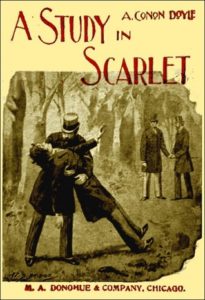
A Study in Scarlet PDF - Arthur Conan Doyle
Arthur Conan Doyle • Crime novels and mysteries • 180 Pages
(0)
Quate
Review
Save
Share
Book Description
Arthur Conan Doyle’s A Study in Scarlet is a detective novel first published in 1887 in Beeton’s Christmas Annual by Ward, Lock & Co.; its first book edition followed in 1888, also from Ward, Lock & Co. Written by Arthur Conan Doyle, the novel is best known as the first appearance of Sherlock Holmes and Dr. John H. Watson, two characters who would become central figures in detective fiction. The book introduced Holmes’s methods of observation, deduction, and forensic reasoning, establishing many of the foundations of the modern mystery genre. Compact but influential, A Study in Scarlet combines a London murder investigation with a dramatic backstory set in the American West, creating a structure that is unusual but memorable.
The novel begins with Dr. John Watson, a former army surgeon recently returned to England after being wounded during the Second Anglo-Afghan War. Struggling with poor health and limited finances, Watson looks for affordable lodgings in London. Through a mutual acquaintance, he is introduced to Sherlock Holmes, an eccentric and highly intelligent man who is also searching for someone to share rooms with him. Watson and Holmes agree to live together at 221B Baker Street, where Watson gradually becomes fascinated by Holmes’s strange habits, scientific experiments, and remarkable ability to draw conclusions from small details.
At first, Watson cannot understand Holmes’s profession. Holmes appears to know a great deal about chemistry, crime, and human behavior, while showing little interest in subjects he considers irrelevant. Watson eventually learns that Holmes works as a “consulting detective,” assisting both private clients and official police investigators when difficult cases arise. This explanation soon becomes practical when Holmes is called to investigate a mysterious death at an empty house in Brixton.
The victim, Enoch Drebber, is found dead in a room with no visible wound. A wedding ring is discovered nearby, and the word “RACHE” is written in blood on the wall. Scotland Yard detectives Lestrade and Gregson form their own theories, but Holmes studies the scene carefully and identifies clues that others overlook, including footprints, cigar ash, and marks left by a carriage. His investigation reveals that Drebber was not killed by ordinary violence, and that the murder is connected to events from the victim’s past.
As the case develops, another man, Joseph Stangerson, is also found dead. Holmes continues to work independently while allowing the police to follow misleading lines of inquiry. Eventually, he identifies the murderer as Jefferson Hope, a cab driver who has been moving through London unnoticed. Holmes’s capture of Hope demonstrates his ability to connect physical evidence with human motive, turning scattered details into a coherent explanation.
The second part of A Study in Scarlet shifts away from London and tells the backstory behind the murders. It follows John Ferrier and a young girl named Lucy, who are rescued in the desert by a Mormon community in Utah. Ferrier raises Lucy as his adopted daughter, but conflict grows when powerful men in the community try to force her into marriage. Lucy loves Jefferson Hope, a man outside the group, yet she is pressured into marrying Enoch Drebber. This tragedy leads to Ferrier’s death, Lucy’s suffering, and Hope’s long pursuit of revenge against Drebber and Stangerson.
When the story returns to London, Jefferson Hope explains his actions. He has spent years tracking the two men he holds responsible for destroying the woman he loved and the man who cared for her. His revenge is personal, deliberate, and shaped by grief. Although Hope is arrested, his poor health brings the case to an abrupt conclusion before he can stand trial. Holmes, meanwhile, receives little official credit, as the police claim public recognition for solving the crime.
A Study in Scarlet is important not only for its plot but also for the relationship it establishes between Holmes and Watson. Watson serves as narrator, observer, and companion, allowing readers to experience Holmes’s brilliance from the outside. The novel introduces the famous detective’s personality: analytical, confident, unconventional, and sometimes impatient with ordinary thinking. While later Sherlock Holmes stories would refine the formula, this first novel already contains the essential appeal of Doyle’s detective fiction: a puzzling crime, careful reasoning, vivid atmosphere, and a dramatic solution rooted in human passion.
Arthur Conan Doyle
Agatha Christie is one of the most influential and widely read writers in the history of detective fiction, a British author whose name has become almost synonymous with mystery, crime, suspense, and the perfectly constructed literary puzzle. Born in England in 1890, Christie developed a lifelong fascination with storytelling, human behavior, secrets, and the hidden motives that can lie beneath ordinary social life. Her fiction is famous for combining elegant simplicity with extraordinary technical control: a body is discovered, a group of suspects is gathered, motives begin to surface, and the truth remains carefully concealed until the final revelation reshapes everything the reader thought they understood. What makes Agatha Christie especially remarkable is not only the number of books she wrote, but the precision with which she transformed the detective story into a form of intellectual entertainment. Her novels invite readers to become investigators, to notice small details, to weigh testimony, to question appearances, and to discover that the most important clue is often hidden in plain sight. Christie created some of the most recognizable characters in world literature, especially Hercule Poirot and Miss Marple. Hercule Poirot, the Belgian detective with his orderly mind, careful manners, and famous reliance on psychological insight, represents the power of logic, method, and close observation. Miss Marple, by contrast, appears modest and gentle, yet her deep understanding of village life and human nature allows her to interpret crime through patterns of behavior she has seen before. Through these two figures, Christie showed that detection could be both rational and intuitive, both analytical and humane. Her most celebrated works include Murder on the Orient Express, And Then There Were None, The Murder of Roger Ackroyd, Death on the Nile, The A.B.C. Murders, and A Murder Is Announced. These books remain popular because they combine suspense with memorable settings: a snowbound train, an isolated island, a river steamer, a country house, a quiet village, or a seemingly respectable family gathering. Christie understood that a confined setting increases tension, forcing characters to reveal themselves under pressure while the reader searches for the pattern behind their lies. Her storytelling rarely depends on graphic violence; instead, it relies on atmosphere, misdirection, dialogue, motive, and timing. She also wrote for the stage, and The Mousetrap became one of the most famous long-running plays in theatre history, proving that her sense of suspense could work as powerfully before a live audience as it did on the page. Agatha Christie’s prose is clear, economical, and accessible, which partly explains her global appeal. Yet beneath that clarity is a highly disciplined narrative intelligence. She knew when to withhold information, when to plant a clue, when to allow a suspect to appear guilty, and when to overturn expectations without cheating the reader. Her work reflects the social world of twentieth-century Britain, including class, manners, domestic life, inheritance, travel, marriage, reputation, and the tensions between public respectability and private desire. For modern readers, Christie’s novels offer more than clever endings. They offer a portrait of how people hide shame, ambition, resentment, fear, and longing behind polite conversation. Her influence can be seen in countless crime novels, television series, films, and detective stories that continue to use and reinvent the classic mystery structure she perfected. For book websites, libraries, and readers searching for classic crime fiction, Agatha Christie remains an essential author. Her legacy rests on the rare combination of popularity, originality, craftsmanship, and enduring readability. Decades after her death, her stories continue to challenge, entertain, and surprise readers, confirming her place as the enduring queen of mystery fiction.
Earn Rewards While Reading!
Every 10 pages you read and spent 30 seconds on every page, earns you 5 reward points! Keep reading to unlock achievements and exclusive benefits.
Read
Rate Now
5 Stars
4 Stars
3 Stars
2 Stars
1 Stars
A Study in Scarlet Quotes
Top Rated
Latest
Quate
Be the first to leave a quote and earn 10 points
instead of 3
Other books by Arthur Conan Doyle
Other books like A Study in Scarlet
'%20/%3e%3c/svg%3e "The Harbinger: The Ancient Mystery that Holds the Secret of America's Future")
Jonathan Cahn.
Crime novels and mysteries
(0)
3009
English
Jonathan Cahn.
Crime novels and mysteries
(0)
2675
English
Comments
Be the first to leave a comment and earn 5 points
instead of 3