

The source of the book
This book is published for the public benefit under a Creative Commons license, or with the permission of the author or publisher. If you have any objections to its publication, please contact us.
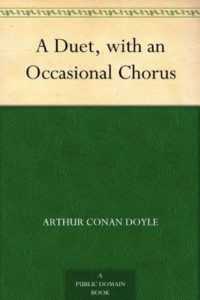
A Duet with an Occasional Chorus PDF - Arthur Conan Doyle
Arthur Conan Doyle • Crime novels and mysteries • 193 Pages
(0)
Quate
Review
Save
Share
Book Description
A Duet with an Occasional Chorus is a domestic romance novel by Arthur Conan Doyle, first published in 1899 by Grant Richards in London; the American edition appeared the same year from D. Appleton & Co. The Project Gutenberg text is transcribed from the 1899 Grant Richards edition, whose title page lists “A. Conan Doyle,” London, Grant Richards, 1899. Though Doyle is best known for Sherlock Holmes, this novel belongs to a very different part of his work: a gentle, humorous study of courtship, marriage, money, trust, and the ordinary pressures of late-Victorian middle-class life.
The novel centers on Frank Crosse and Maude Selby, a young couple deeply in love and eager to marry. The opening chapters are built around their letters, which capture both the comedy and sincerity of engagement. Frank repeatedly tries to move the wedding date earlier, while Maude balances affection, family expectations, dressmaking, and social propriety. Their exchanges establish the book’s light musical metaphor: the “duet” is the private harmony between husband and wife, while the “occasional chorus” is made up of family, friends, servants, neighbors, lawyers, and social visitors who keep intruding on married life.
After the wedding, Frank and Maude set up home at The Lindens in Woking. Much of the plot follows their adjustment to marriage rather than a single sensational adventure. Doyle pays close attention to practical domestic matters: income, furniture, meals, servants, callers, household management, and the emotional labor required to keep a small home cheerful. Frank earns a modest salary, and Maude, raised in comfort, must learn the realities of a narrower budget. Their love is sincere, but the novel does not pretend that affection removes all difficulty. Instead, it shows how small misunderstandings, financial anxieties, and social conventions test their patience.
The most serious financial crisis comes through Frank’s connection with Farintosh, an insurance agent for whom he has become surety. When Farintosh’s accounts show a deficit, the Hotspur Insurance Company seeks payment from Frank. The claim grows to £340, a sum that could ruin the young household, and Frank is forced into legal uncertainty. The episode brings strain, but it also shows Maude’s loyalty and resourcefulness. She does not remain a passive wife; she thinks practically, consults family resources, and stands beside Frank as a partner.
Another emotional conflict arrives when Violet Wright, a woman from Frank’s past, reappears. Her visit to Maude introduces jealousy, insecurity, and the uncomfortable fact that marriage does not erase previous attachments. Violet’s presence is less a melodramatic villainy than a disturbance of the couple’s ideal harmony. Maude must face the idea that Frank had a life before her, while Frank must prove that honesty and present devotion matter more than old romance.
The final movement of A Duet with an Occasional Chorus turns toward parenthood. The “duet” becomes a “trio” as Maude prepares for childbirth, and Doyle presents this change as both joyful and unsettling. Frank’s tenderness, fear, and helplessness deepen the domestic portrait. By the close, the novel affirms marriage not as a flawless dream, but as a shared discipline of patience, forgiveness, humor, and everyday courage. For readers interested in Arthur Conan Doyle beyond Sherlock Holmes, A Duet with an Occasional Chorus offers a warm, observant look at love after the wedding, where the real plot is the making of a life together.
Arthur Conan Doyle
Agatha Christie is one of the most influential and widely read writers in the history of detective fiction, a British author whose name has become almost synonymous with mystery, crime, suspense, and the perfectly constructed literary puzzle. Born in England in 1890, Christie developed a lifelong fascination with storytelling, human behavior, secrets, and the hidden motives that can lie beneath ordinary social life. Her fiction is famous for combining elegant simplicity with extraordinary technical control: a body is discovered, a group of suspects is gathered, motives begin to surface, and the truth remains carefully concealed until the final revelation reshapes everything the reader thought they understood. What makes Agatha Christie especially remarkable is not only the number of books she wrote, but the precision with which she transformed the detective story into a form of intellectual entertainment. Her novels invite readers to become investigators, to notice small details, to weigh testimony, to question appearances, and to discover that the most important clue is often hidden in plain sight. Christie created some of the most recognizable characters in world literature, especially Hercule Poirot and Miss Marple. Hercule Poirot, the Belgian detective with his orderly mind, careful manners, and famous reliance on psychological insight, represents the power of logic, method, and close observation. Miss Marple, by contrast, appears modest and gentle, yet her deep understanding of village life and human nature allows her to interpret crime through patterns of behavior she has seen before. Through these two figures, Christie showed that detection could be both rational and intuitive, both analytical and humane. Her most celebrated works include Murder on the Orient Express, And Then There Were None, The Murder of Roger Ackroyd, Death on the Nile, The A.B.C. Murders, and A Murder Is Announced. These books remain popular because they combine suspense with memorable settings: a snowbound train, an isolated island, a river steamer, a country house, a quiet village, or a seemingly respectable family gathering. Christie understood that a confined setting increases tension, forcing characters to reveal themselves under pressure while the reader searches for the pattern behind their lies. Her storytelling rarely depends on graphic violence; instead, it relies on atmosphere, misdirection, dialogue, motive, and timing. She also wrote for the stage, and The Mousetrap became one of the most famous long-running plays in theatre history, proving that her sense of suspense could work as powerfully before a live audience as it did on the page. Agatha Christie’s prose is clear, economical, and accessible, which partly explains her global appeal. Yet beneath that clarity is a highly disciplined narrative intelligence. She knew when to withhold information, when to plant a clue, when to allow a suspect to appear guilty, and when to overturn expectations without cheating the reader. Her work reflects the social world of twentieth-century Britain, including class, manners, domestic life, inheritance, travel, marriage, reputation, and the tensions between public respectability and private desire. For modern readers, Christie’s novels offer more than clever endings. They offer a portrait of how people hide shame, ambition, resentment, fear, and longing behind polite conversation. Her influence can be seen in countless crime novels, television series, films, and detective stories that continue to use and reinvent the classic mystery structure she perfected. For book websites, libraries, and readers searching for classic crime fiction, Agatha Christie remains an essential author. Her legacy rests on the rare combination of popularity, originality, craftsmanship, and enduring readability. Decades after her death, her stories continue to challenge, entertain, and surprise readers, confirming her place as the enduring queen of mystery fiction.
Earn Rewards While Reading!
Every 10 pages you read and spent 30 seconds on every page, earns you 5 reward points! Keep reading to unlock achievements and exclusive benefits.
Read
Rate Now
5 Stars
4 Stars
3 Stars
2 Stars
1 Stars
A Duet with an Occasional Chorus Quotes
Top Rated
Latest
Quate
Be the first to leave a quote and earn 10 points
instead of 3
Other books by Arthur Conan Doyle
Other books like A Duet with an Occasional Chorus
'%20/%3e%3c/svg%3e "The Harbinger: The Ancient Mystery that Holds the Secret of America's Future")
Jonathan Cahn.
Crime novels and mysteries
(0)
3022
English
Jonathan Cahn.
Crime novels and mysteries
(0)
2682
English
Comments
Be the first to leave a comment and earn 5 points
instead of 3