
Newly released
This book is new and will be uploaded as soon as it becomes available to us and if we secure the necessary publishing rights.
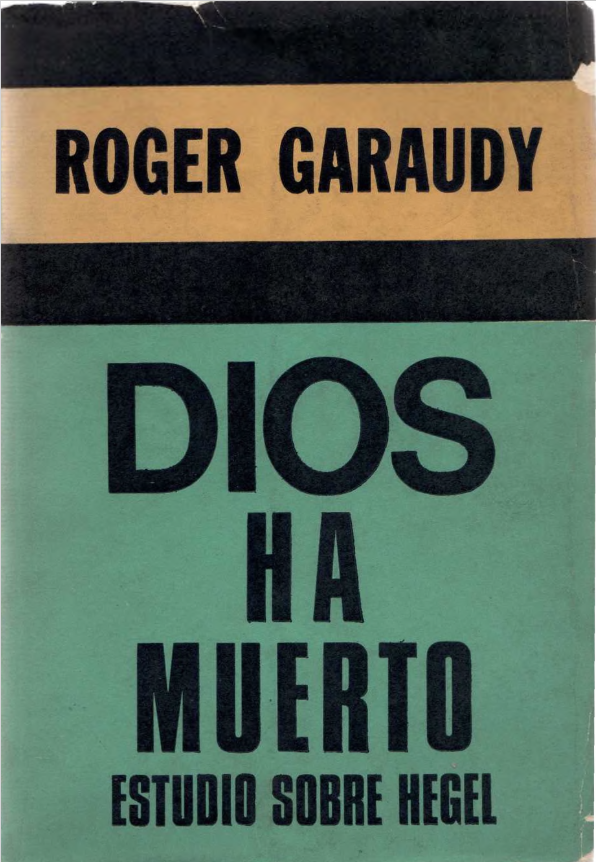
Dios ha muerto. Estudio sobre Hegel PDF - Roger Garaudy
Roger Garaudy • Literary novels • 396 Pages
(0)
Quate
Review
Save
Share
Book Description
Hegel ha planteado un problema que nuestro siglo trata de resolver. El filósofo vivió el desmoronamiento de un mundo y el surgimiento de otro. El método que elaboró para tratar de desentrañar los desgarra mientos y las contradicciones de su tiempo —la dialéctica idealista— sólo puede ser comprendido si se parte de la experiencia viva y del drama experimentado que fueron los que suscitaron su exigencia filo sófica.
Esa experiencia y ese drama deben primero ser restituidos en su complejidad y su totalidad. El sistema hegeliano no es la conclusión de una especie de silo gismo histórico a cuyo término el idealismo absoluto de Hegel vendría a reemplazar, por necesidad lógica, al idealismo subjetivo de Fichte y
al idealismo objetivo de Schelling. Aunque Hegel haya dado a este esquema la garantía de su propia Historia d e la filosofía, la génesis de su pensamiento es infinitamente más rica: la identificación de las doc trinas no es más que un momento y por tanto es secundario.
Roger Garaudy
Roger Garaudy was a French philosopher, writer, political thinker, and public intellectual whose long career made him one of the most discussed and controversial European authors of the twentieth century. Born in 1913, Garaudy first became known through his commitment to Marxist philosophy, anti-fascist resistance, and the intellectual life of the French left. For decades he was associated with the French Communist Party and wrote extensively on Marxism, realism, art, history, and the role of human beings in social transformation. Yet his importance as an author does not rest only on his early political writings. What makes Roger Garaudy especially significant for readers of philosophy, religion, and modern history is the remarkable evolution of his thought. He moved from a strongly ideological framework toward a broader search for spiritual meaning, civilizational dialogue, and moral renewal. His books often ask large questions: What is the purpose of human progress? Can modern civilization survive without a spiritual foundation? How can different cultures recognize one another without domination? Why has technological development failed to produce a more humane world? These themes made his work especially influential among readers interested in the relationship between Western modernity, religion, Islam, and global ethics. One of his best-known works, often translated as “Dialogue of Civilizations,” presents his argument that no single culture can claim ownership of universal truth and that humanity must recover the contributions of many civilizations, including Islamic, African, Asian, and indigenous traditions. Another widely read work, “Promises of Islam,” reflects his later admiration for Islam as a religious and social vision that, in his interpretation, offered balance between faith, justice, community, and responsibility. Garaudy embraced Islam in the early 1980s, a decision that deeply shaped his reputation in the Arab and Muslim worlds. Many readers in these regions encountered him as a Western intellectual who challenged materialism, criticized colonial attitudes, and presented Islam as a living civilizational force rather than a relic of the past. His writing style is dense, argumentative, and often sweeping in scope. He frequently combines philosophy, history, theology, political critique, and cultural analysis in a single narrative, which gives his books both intellectual ambition and rhetorical force. At the same time, any accurate author description must acknowledge that Garaudy remains a controversial figure. His later political positions, especially his writings on Zionism, Israel, and the Holocaust, generated fierce criticism and legal consequences in France. For this reason, his legacy is complex: he is admired by some as a defender of civilizational dialogue and spiritual humanism, while others criticize him for polemical arguments and historically disputed claims. For a book website, Roger Garaudy can best be presented as a major French thinker whose works appeal to readers of philosophy, Islamic thought, political history, and critiques of modern civilization. His books continue to attract attention because they speak to enduring questions about faith, justice, culture, power, and the future of humanity. Whether approached with admiration, caution, or critical distance, Garaudy remains an author whose intellectual journey reflects many of the great tensions of the modern age.
Book Currently Unavailable
This book is currently unavailable for publication. We obtained it under a Creative Commons license, but the author or publisher has not granted permission to publish it.
Rate Now
5 Stars
4 Stars
3 Stars
2 Stars
1 Stars
Dios ha muerto. Estudio sobre Hegel Quotes
Top Rated
Latest
Quate
Be the first to leave a quote and earn 10 points
instead of 3
'%20/%3e%3c/svg%3e "El pensamiento de Hegel")
Comments
Be the first to leave a comment and earn 5 points
instead of 3