

مصدر الكتاب
تم نشر هذا الكتاب بهدف النفع العام، وذلك بموجب رخصة المشاع الإبداعي، أو بناءً على موافقة من المؤلف أو دار النشر. في حال وجود أي اعتراض على النشر، يُرجى التواصل معنا لنتخذ الإجراء المناسب.
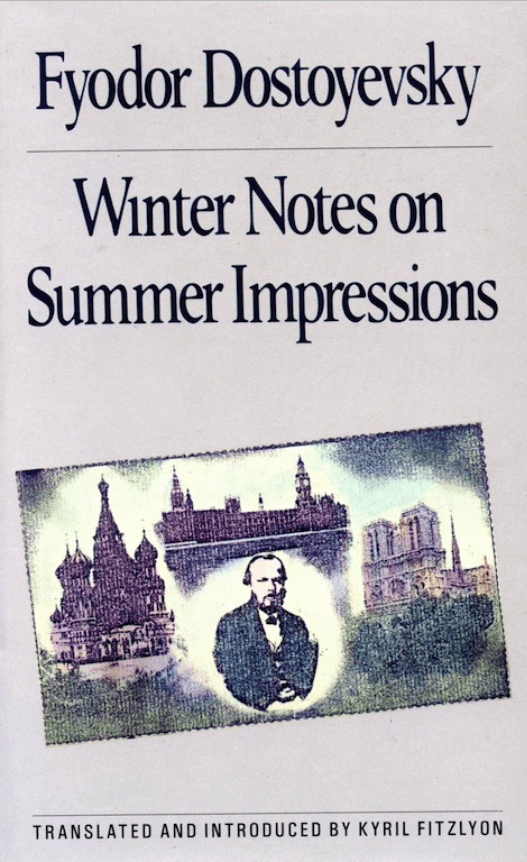
Winter Notes on Summer Impressions PDF - فيودور دوستويفسكي
فيودور دوستويفسكي • أدب • ١١٣ الصفحات
(0)
اقتباس
مراجعة
حفظ
مشاركة
وصف الكتاب
Winter Notes on Summer Impressions by Fyodor Dostoevsky
Winter Notes on Summer Impressions is one of Fyodor Dostoevsky’s most revealing early nonfiction works, a sharp, restless, and often provocative travel essay born from his first journey through Western Europe in 1862. Written after his return to Russia and first published in 1863, the book transforms a summer trip into a winter meditation on civilization, modernity, national character, faith, social inequality, and the uneasy relationship between Russia and the West. Rather than offering a simple travel diary, Dostoevsky turns his impressions of cities such as Paris, London, Berlin, Florence, Milan, and Vienna into a searching critique of European society and of the Russian fascination with European models.
A Travel Book with the Mind of a Novelist
Readers who know Dostoevsky through Crime and Punishment, The Brothers Karamazov, The Idiot, or Notes from Underground will find in this shorter work an important glimpse of the author’s developing intellectual world. Winter Notes on Summer Impressions is not a conventional guide to Europe, nor is it a neutral report of landmarks and customs. It is the work of a novelist, polemicist, and moral psychologist observing crowds, streets, institutions, wealth, poverty, manners, entertainment, religion, and social ideals with a gaze that is skeptical, intense, and deeply personal.
The book’s title captures its unusual form: summer experiences are reconsidered in the reflective cold of winter. Dostoevsky writes not merely about what he saw, but about what those sights came to mean. The result is a blend of Russian literature, travel writing, cultural criticism, philosophical essay, and social commentary. His voice is conversational yet biting, humorous yet severe, full of sudden turns, confessions, exaggerations, and insights. This makes the book especially valuable for readers interested in Dostoevsky beyond fiction, because it shows the author testing ideas that would later become central to his greatest novels.
Europe, Russia, and the Question of Modern Civilization
At the center of Winter Notes on Summer Impressions is Dostoevsky’s encounter with Western European modernity. Europe had long represented progress, refinement, rational organization, political ideals, and cultural prestige for many educated Russians. Dostoevsky approaches that image with suspicion. He is fascinated by Europe, but not dazzled by it. He studies its cities as symbols of a civilization that has gained wealth, order, industry, and confidence, while in his view often losing spiritual depth, human tenderness, and moral unity.
London and Paris become more than destinations; they become living arguments. In London, Dostoevsky is struck by scale, energy, commerce, machinery, crowds, poverty, and the unsettling grandeur of the modern industrial city. In Paris, he turns his attention to bourgeois respectability, social performance, public manners, and the polished surface of a society that he sees as inwardly constrained. His observations are subjective and often controversial, but that subjectivity is part of the book’s power. Dostoevsky is not trying to disappear behind his material. He makes the reader feel the pressure of a mind wrestling with civilization itself.
A Key Work for Understanding Dostoevsky’s Later Ideas
Although Winter Notes on Summer Impressions is less famous than Dostoevsky’s major novels, it is often read as a significant step toward the themes of Notes from Underground, published shortly afterward. The book contains early versions of Dostoevsky’s suspicion of rational egoism, mechanical progress, material comfort, social engineering, and the belief that human beings can be fully explained or perfected through systems. Many readers and commentators have seen it as a work that anticipates the sharper psychological and philosophical conflicts of his later fiction.
This connection makes the book especially rewarding for students of Dostoevsky’s philosophy, Russian intellectual history, nineteenth-century literature, and the debate between Westernizers and Slavophiles. Dostoevsky’s Europe is not simply geographical; it is ideological. He is asking what happens when societies define happiness by comfort, freedom by consumption, morality by respectability, and progress by visible order. His answers are not calm or systematic, but they are unforgettable because they emerge through scenes, impressions, irony, and emotional argument.
Style, Tone, and Reading Experience
The reading experience of Winter Notes on Summer Impressions is lively, uneven, brilliant, and deliberately personal. Dostoevsky’s narrator often seems to challenge the reader directly, admitting limitations, shifting tone, and refusing the balanced posture of a detached observer. This gives the essay a distinctive immediacy. The book can feel like a conversation with a restless intelligence: one moment comic, the next severe; one moment anecdotal, the next philosophical; one moment describing a street, the next attacking an entire social order.
For readers expecting the dramatic plots of Dostoevsky’s novels, this work offers something different but closely related. There are no fictional murders, trials, confessions, or family catastrophes here, yet the same moral urgency is present. Dostoevsky’s attention is fixed on the human soul under pressure: the poor in the modern city, the complacency of the comfortable classes, the illusions of reformers, the loneliness hidden beneath public order, and the spiritual hunger that material success cannot satisfy. The book’s energy lies in this movement from observation to judgment, from travel note to moral diagnosis.
Who Should Read Winter Notes on Summer Impressions?
Winter Notes on Summer Impressions is an excellent choice for readers who want to explore Dostoevsky’s nonfiction, understand the background of his later masterpieces, or examine nineteenth-century debates about Europe, Russia, faith, socialism, capitalism, and modern life. It is particularly suited to readers interested in classic Russian literature, literary essays, philosophical travel writing, European cultural history, and the roots of modern social criticism.
The book also appeals to those who appreciate shorter works by major authors. While Dostoevsky’s great novels demand long immersion, this essay offers a concentrated encounter with his voice and worldview. It can be read as a companion to Notes from Underground, as a bridge between his early and mature periods, or as a standalone work of fierce cultural observation. Readers who enjoy writers who combine travel with argument, such as political essayists, social critics, and literary philosophers, will find much to consider in these pages.
A Sharp and Memorable Portrait of Europe Through Russian Eyes
What makes Winter Notes on Summer Impressions by Fyodor Dostoevsky enduring is not that its judgments are always fair or comfortable, but that they are alive. Dostoevsky looks at Europe with admiration, irritation, suspicion, and fascination all at once. He sees magnificent cities and spiritual emptiness, public order and hidden suffering, polished manners and moral anxiety. His Europe is filtered through the concerns of a Russian writer who believed that the future of his own country depended on more than imitation of Western models.
This is a book of impressions, but those impressions open into large questions. What is civilization without compassion? What is freedom without spiritual responsibility? What does progress cost when it treats people as crowds, types, or functions? Can a society be rich and still be inwardly impoverished? These questions would continue to echo throughout Dostoevsky’s fiction, giving Winter Notes on Summer Impressions a lasting importance far beyond its modest length.
An Essential Addition to a Dostoevsky Collection
For anyone building a deeper understanding of Fyodor Dostoevsky, Winter Notes on Summer Impressions offers an essential perspective. It reveals the author not through invented characters but through his own searching, argumentative, and deeply moral response to the modern world. The book stands as a compact yet powerful work of classic travel literature, Russian social thought, and nineteenth-century cultural criticism, showing Dostoevsky at a turning point in his artistic and philosophical development.
Thoughtful, sharp, and frequently unsettling, Winter Notes on Summer Impressions remains a valuable read for anyone interested in the ideas behind Dostoevsky’s fiction and the broader conflict between material progress and spiritual meaning. It is a book that turns travel into inquiry, observation into critique, and a summer journey through Europe into one of the most distinctive reflections in Russian literary nonfiction.
فيودور دوستويفسكي
كان فيودور دوستويفسكي روائيًا وفيلسوفًا وكاتب مقالات روسيًا ، ويُعتبر على نطاق واسع أحد أعظم الكتاب في الأدب الغربي. ولد في موسكو عام 1821 ونشأ في عائلة من الطبقة المتوسطة. كان والده طبيبًا يعالج الفقراء مجانًا ، الأمر الذي غرس في دوستويفسكي إحساسًا عميقًا بالعدالة الاجتماعية والتعاطف مع المضطهدين.
بدأ دوستويفسكي مسيرته الكتابية في أربعينيات القرن التاسع عشر بسلسلة من الروايات والقصص القصيرة التي استكشفت تعقيدات الطبيعة البشرية والجانب المظلم للمجتمع الروسي. نُشرت روايته الرئيسية الأولى "فقراء" عام 1846 وحظيت بإشادة النقاد. ومع ذلك ، كانت أعماله اللاحقة ، مثل "الجريمة والعقاب" و "الأبله" و "الأخوان كارامازوف" ، هي التي جعلت منه أستاذًا أدبيًا.
تشتهر كتابات دوستويفسكي بعمقها النفسي وموضوعاتها الفلسفية واستكشاف حالة الإنسان. غالبًا ما تصارع شخصياته مع المعضلات الأخلاقية والأسئلة الوجودية ، وتتصارع مع قضايا الإيمان والأخلاق ومعنى الحياة. تستكشف أعماله أيضًا القضايا السياسية والاجتماعية في عصره ، بما في ذلك الفقر والجريمة والقمع السياسي.
اتسمت حياة دوستويفسكي بمأساة شخصية واضطراب سياسي. تم القبض عليه في عام 1849 لتورطه مع مجموعة من المثقفين الليبراليين وحُكم عليه بالإعدام ، فقط لتخفف العقوبة إلى الأشغال الشاقة في سيبيريا. عاد إلى روسيا بعد أن قضى عقوبته ، لكنه استمر في النضال ضد الفقر والمرض طوال حياته. توفي عام 1881 عن عمر يناهز 59 عامًا.
على الرغم من حياته المضطربة ، فإن إرث دوستويفسكي ككاتب ومفكر لا يزال قائما. تستمر أعماله في القراءة والدراسة على نطاق واسع اليوم ، ولا تزال أفكاره حول الحالة الإنسانية ودور الإيمان في المجتمع تلقى صدى لدى القراء في جميع أنحاء العالم.
اكسب مكافآت أثناء القراءة!
كل 10 صفحات تقرؤها وتقضى فيها 30 ثانية تمنحك 5 نقاط مكافأة! واصل القراءة لفتح الإنجازات والمزايا الحصرية.
اقرأ
قيم الآن
5 نجوم
4 نجوم
3 نجوم
2 نجوم
1 نجوم
اقتباسات Winter Notes on Summer Impressions
الأعلى تقييماً
الأحدث
اقتباس
كن أول من يترك اقتباسًا واكسب 10 نقاط
بدلاً من 3
'%20/%3e%3c/svg%3e "The Brothers Karamazov")
التعليقات
كن أول من يترك تعليقًا واكسب 5 نقاط
بدلاً من 3